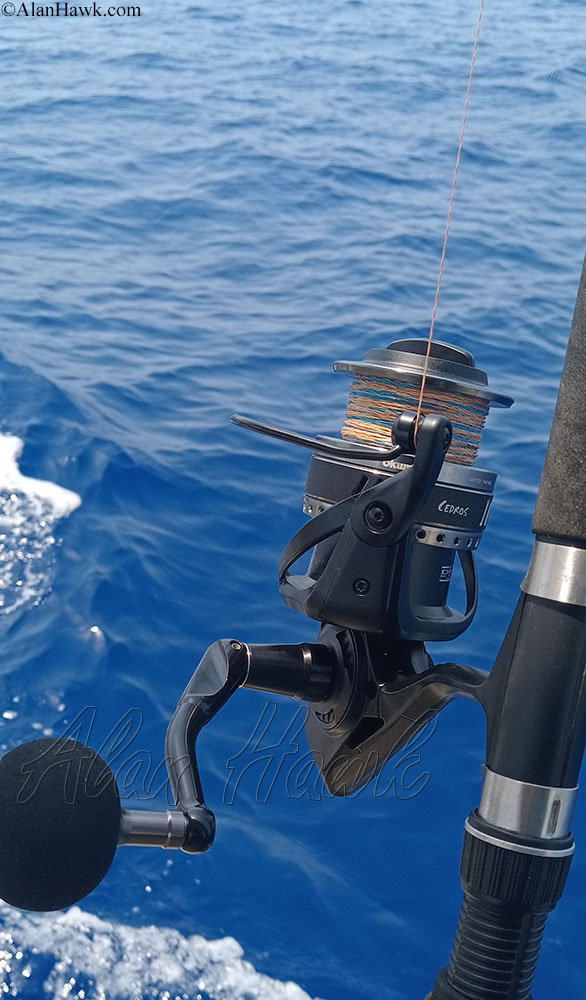
2020 Okuma Cedros : The Review(s?)
Hello fishermen, fisherwomen, and fisherundecided
A casual look at Okuma's current saltwater spinning lineup, focusing on mainline models since Okuma has supplemental regional models, finds the following grouping;
- 2017 Makaira spinning, a high-end reel whose build and capabilities are comparable to Daiwa and Shimano's Saltiga and Stella, even made in the home country of Okuma, Taiwan, to match the prestige of those two Japanese made reels.
- 2023 Tesoro, an upper mid-range spinning reel whose construction and performance are more in line with Shimano's Saragosa SW and Penn's Authority and Slammer 4.
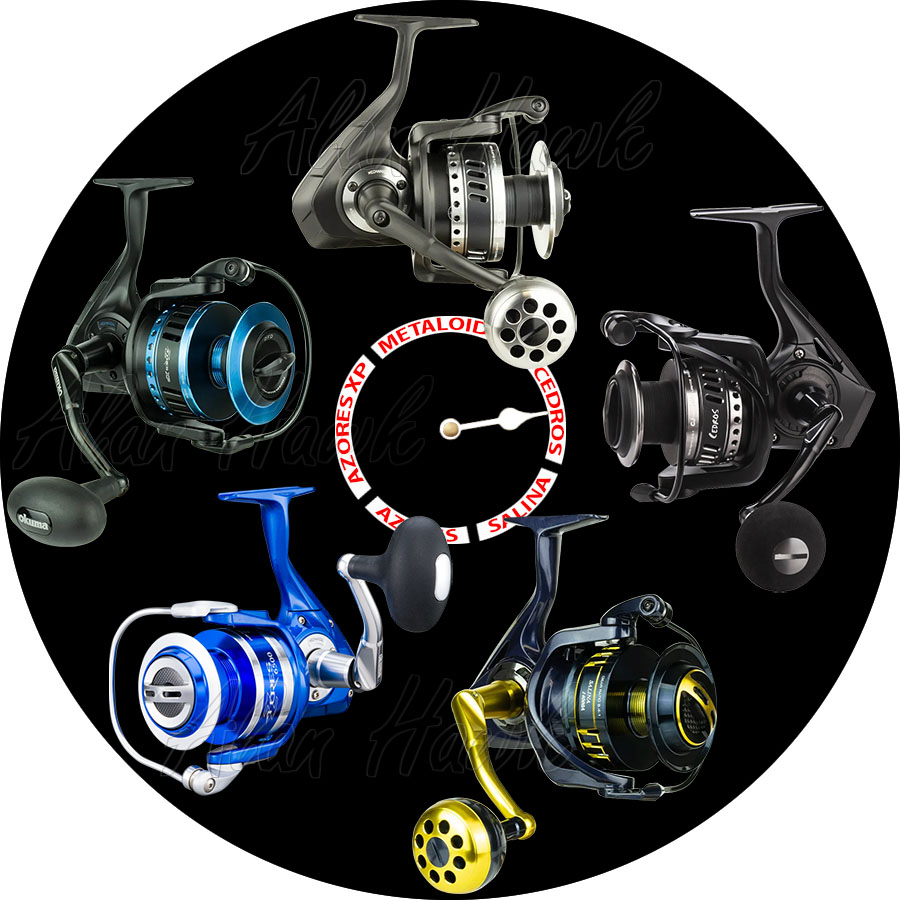
- 2019 Azores, 2019 Metaloid, 2020 Cedros, 2023 Salina, and 2024 Azores XP, five reels that hover right above the borderline separating the top region of entry-level and the bottom area of mid-range, their counterparts, albeit more loosely, being Penn's Spinfisher 7, 2016 Daiwa BG, and Shimano's Spheros SW-A.
- Beneath these there is a whole universe of very basic reels, some of which many of you wouldn't have heard of, such as the Cascade, Revenger/Revenger Pro, Atomic SW, Tundra/Tundra Pro, Safina SW-X, etc. I do not grade or classify the build and performance of this class from any brand due to the sheer number of models and the generic nature of the majority of them.
This grouping only concerns standard saltwater reels therefore no free-lining or long-cast Okumas were included, and in listing the counterparts I did not mention Quantum, another major player that's now officially named the saltwater arm of Zebco's owner Rather Outdoors, because I'm still actively testing their entire line-up which has been relaunched relatively recently after they scrapped all existing reels and started afresh.
While the Cedros is the focus of this article, the entire quintet from that third group happens to be so intrinsically connected you'll essentially be reading a review of the Metaloid, the Salina, and the two Azores models in addition to the Cedros. They aren't exactly spin-offs of one another in the familiar terms, yet their design fundamentals and core performance are virtually indistinguishable to the point that they can't be considered individual reels in any practical sense. I'll be telling you where they notably differ, nonetheless consider everything you'll hear about the Cedros to apply also to the other 4 to a substantial extent.
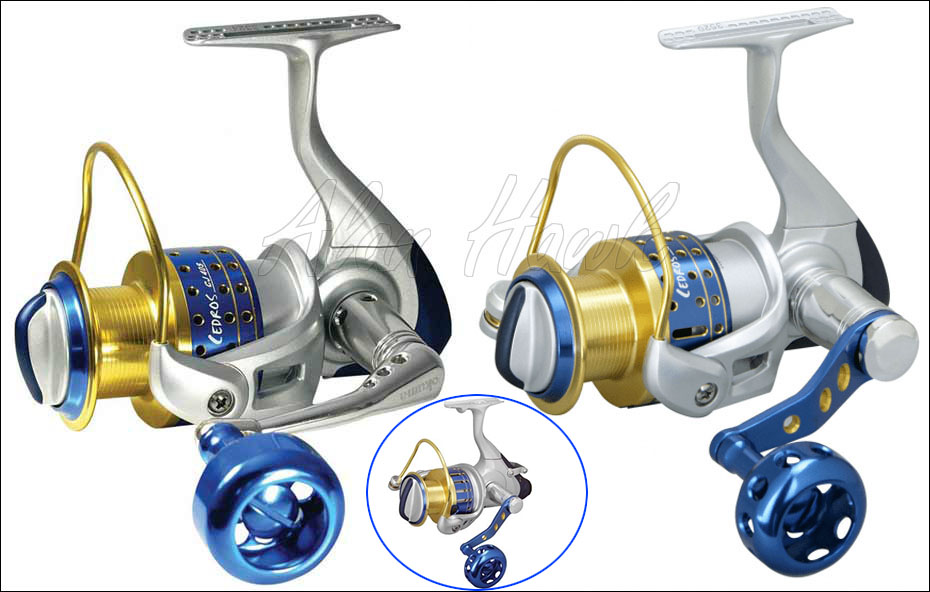
The first generation Cedros debuted in 2010. It was announced and promoted a year earlier, but as usual I'll adopt the year of actual retail sale for veracity and uniformity, therefore it's a 2010 reel. That first Cedros came in two versions; high speed gear ratio with a silver tubular handle stem (left), and a low speed gear ratio with a blue flat handle stem (right). There was also a free-lining version which Okuma called "Baitfeeder" (inset), and it came with the blue flat handle stem since it had identical gear ratios to the standard low speed Cedros.
That 2010 Cedros was intently advertised as a saltwater reel, in what was then an ongoing effort to transform Okuma's public perception from a largely freshwater brand to one that pursues both fresh and saltwater disciplines with the same emphasis. It had typical Okuma features of the period, some of which have since become less ubiquitous such as the Elliptical Oscillation System (EOS), while others still survive today like the Dual Force Drag (DFD). Those original Cedros reels did not stand out as special in any particular fashion, yet they were fairly reliable spinners positioned as secondary reels to the flagship "V-System" with multiple features presented as trickle-downs from that top reel.
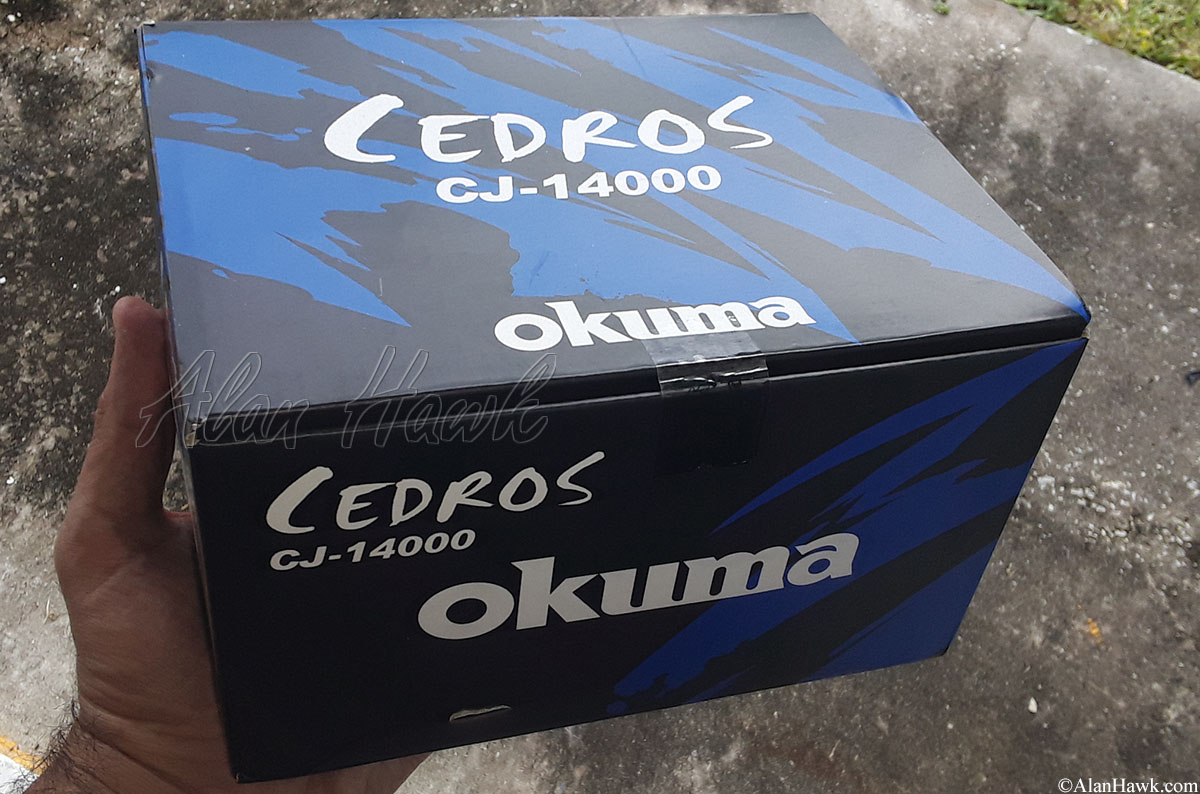
10 years later, Okuma released the 2020 Cedros, and a few months later mine arrived in this neat black and blue box, which has a seal to let me know it wasn't messed with at the shop or sold then returned prior to me acquiring it. I always appreciate box seals, because no matter what shops claim reels returned shortly after purchase are almost always wiped the resold as new. No business can survive taking a hit on every returned reel by selling it as used, and I lost count of the times I received supposed new reels from reputable retailers only to find subtle evidence of prior mounting and even spooling. That whole "no questions asked return" practice needs to be reconsidered because the West is no longer the high trust societies it once was, but that's a subject for another time and I can't begin digressing this early in the review!
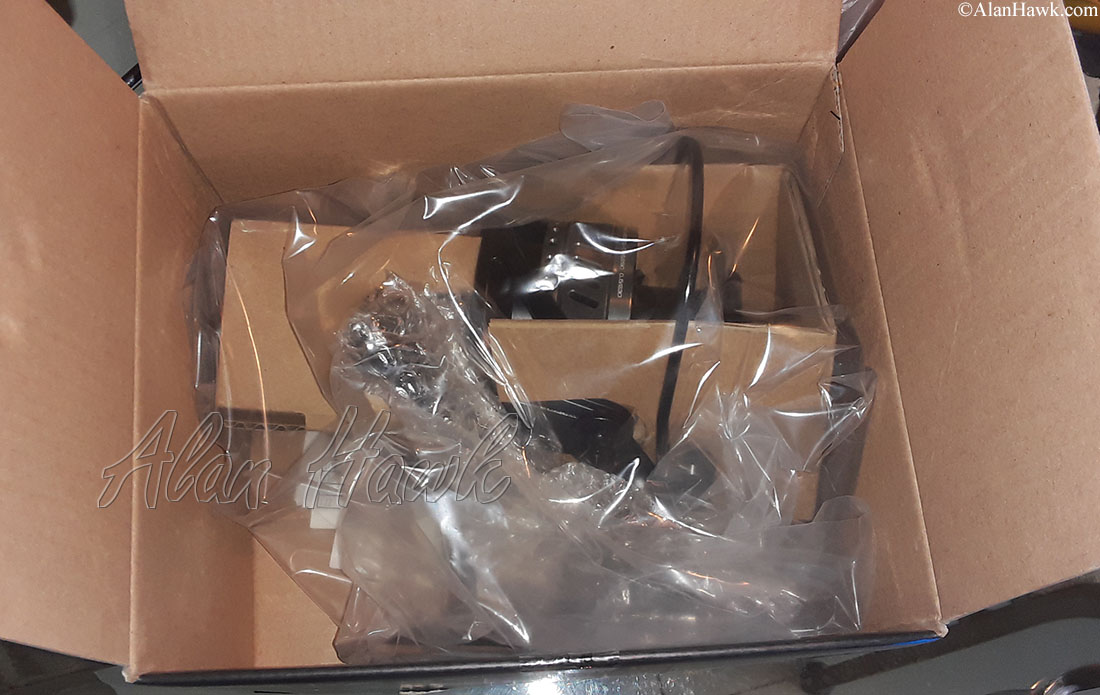
Rudimentary packing in plastic bags and cardboard separators, protective enough for a journey through the mail but not easily reproducible by the user for storage. Having tried all sorts of drawers, cabinets, and bags, I came to realise that nothing beats the efficacy of the original box in protection against humidity and finish damage when stashing reels at season's end.
Before the Cedros poses for her beauty photoshoot, I need to explain that the quality of the photos is lower than usual because you'll be looking through a time portal at its arrival roughly 6 years ago. The Cedros is one of the final reels on the infamous "pandemic backlog", namely reels that were being fished and tested when COVID shut the world down bringing my work to a pause that caused projects to pile up with not enough time to go back to them when life resumed and new reels took precedence....
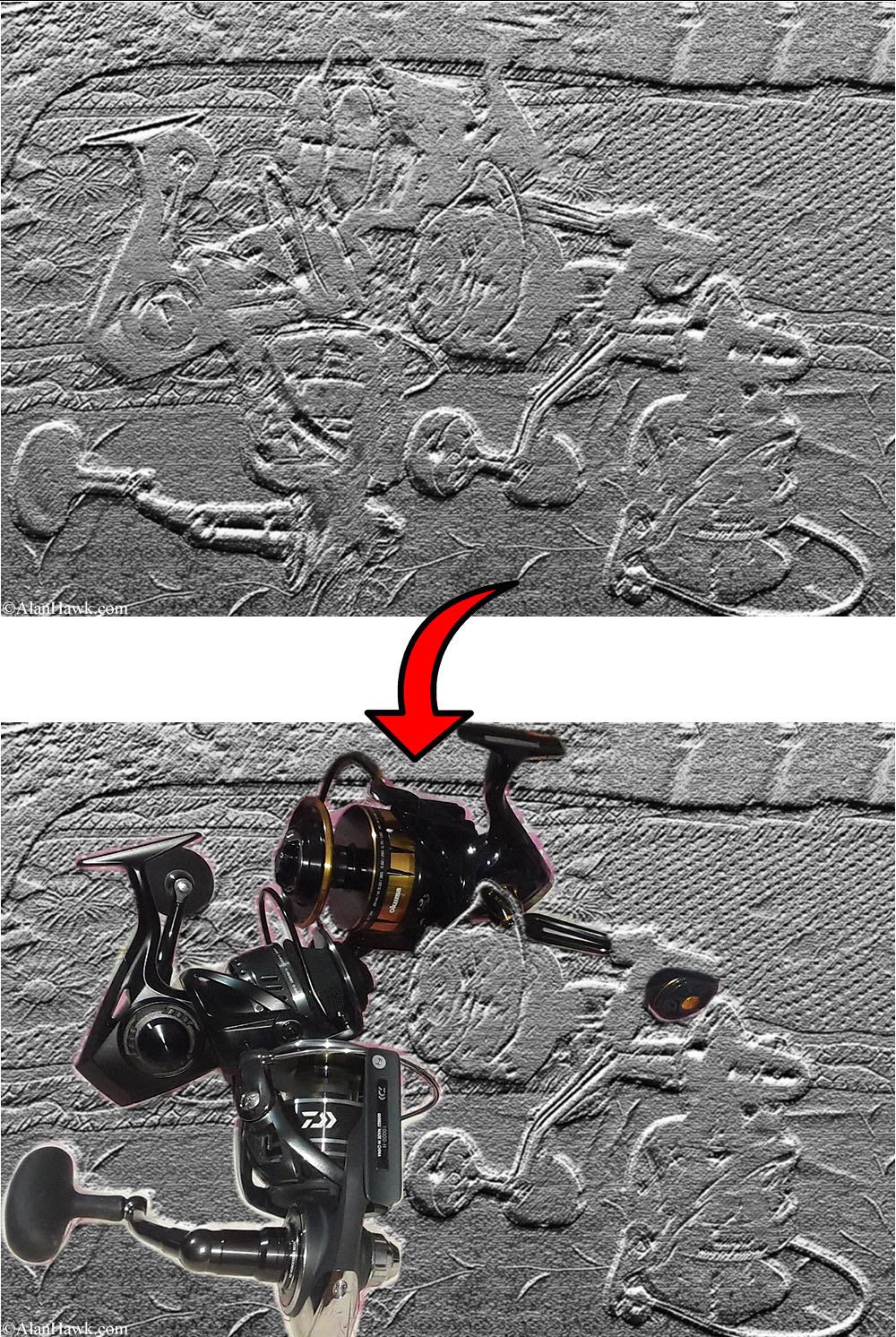
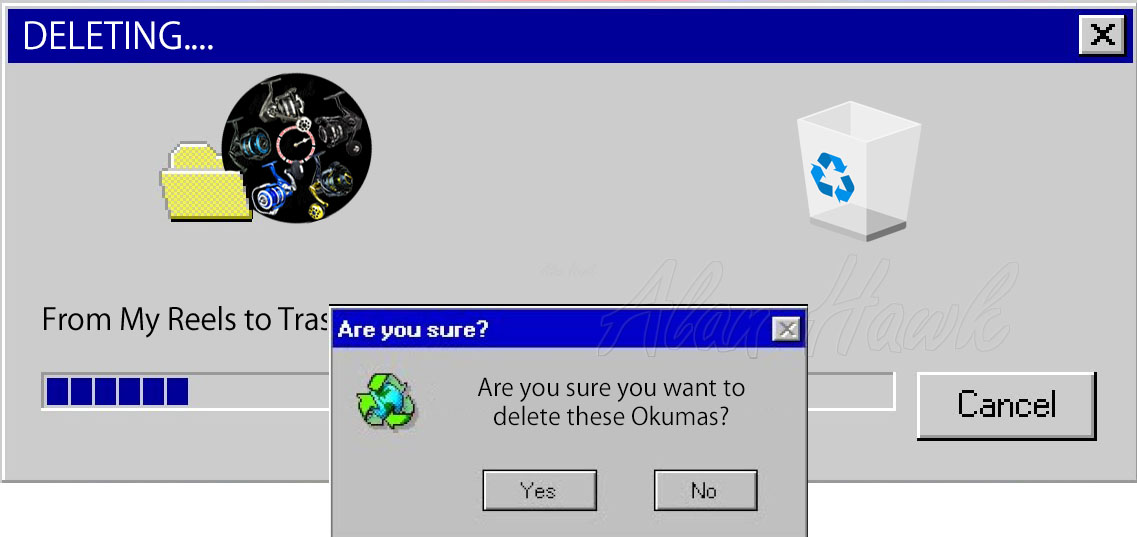
Actually let me unveil it from underneath the fog-of-war in the image I jokingly posted a few years ago as a I whined about that backlog. It's only thanks to Okuma's unusual model longevity that 6 years after release I can still review the Cedros as a relevant current-production model, when for most other brands waiting this long would likely mean that I'd be discussing a discontinued model whose replacement's review is already a year late!!
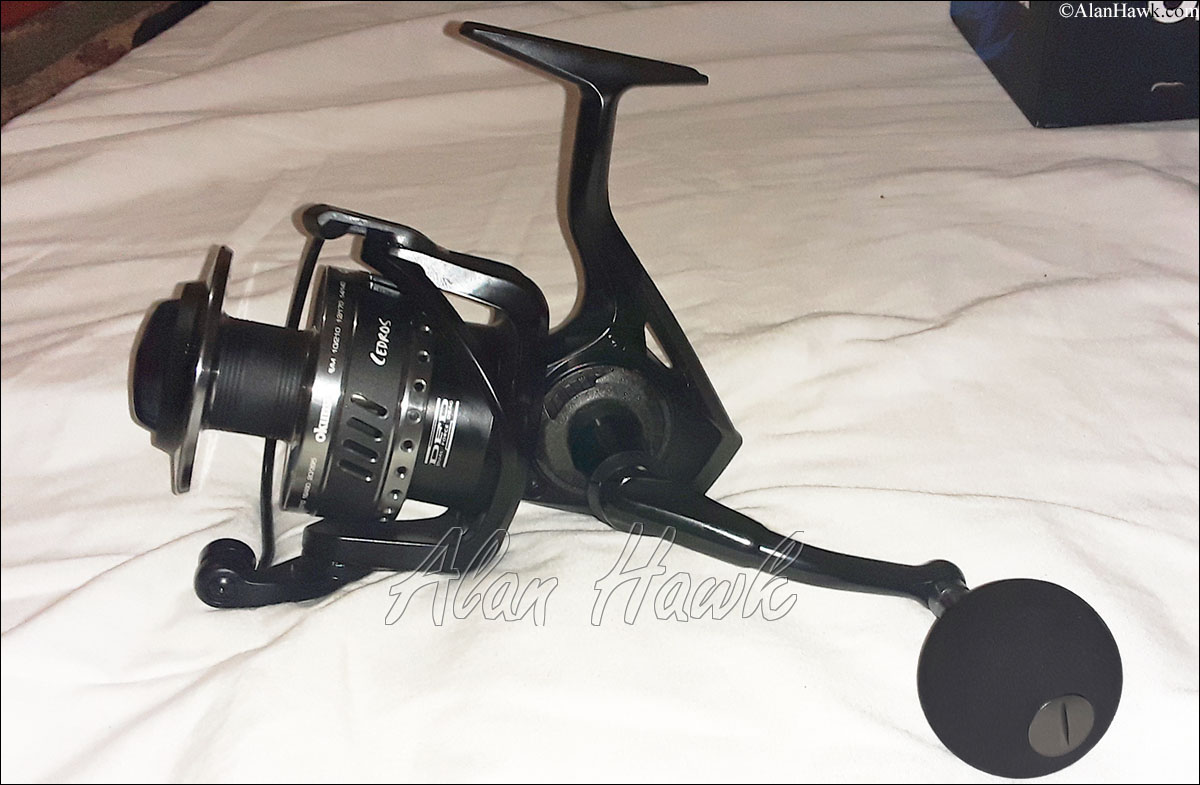
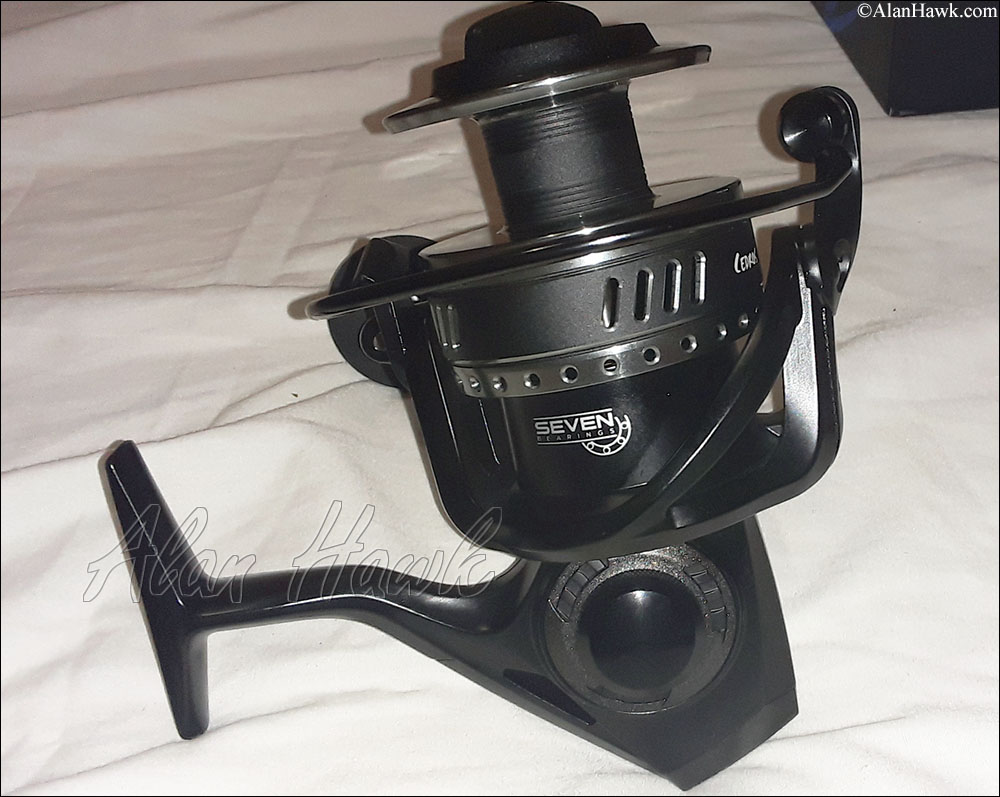
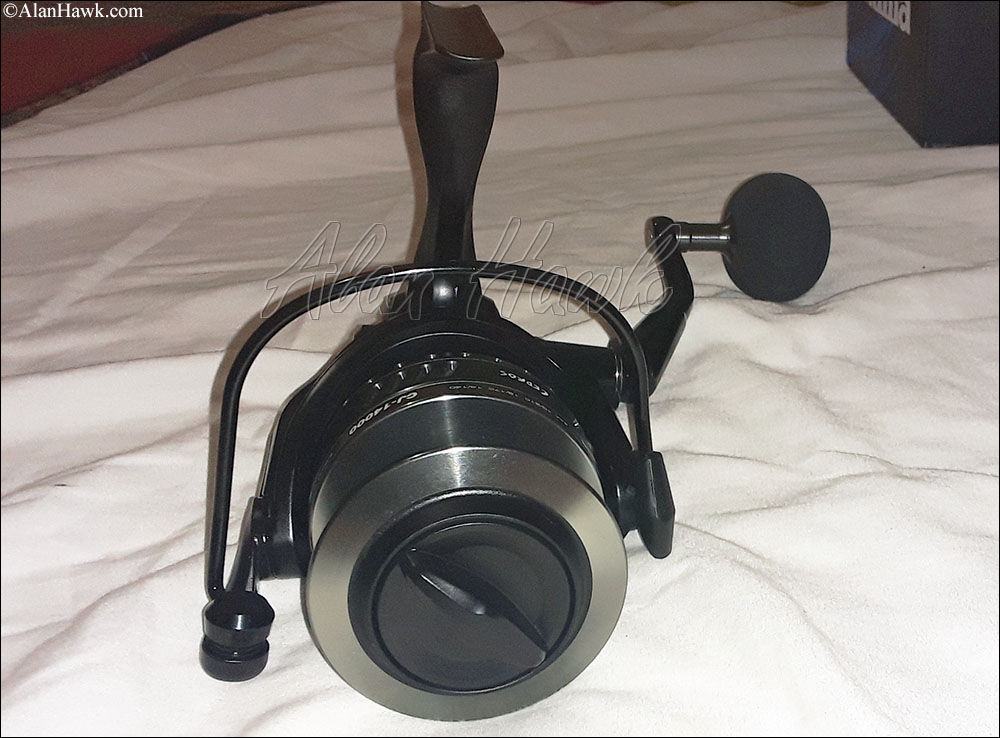
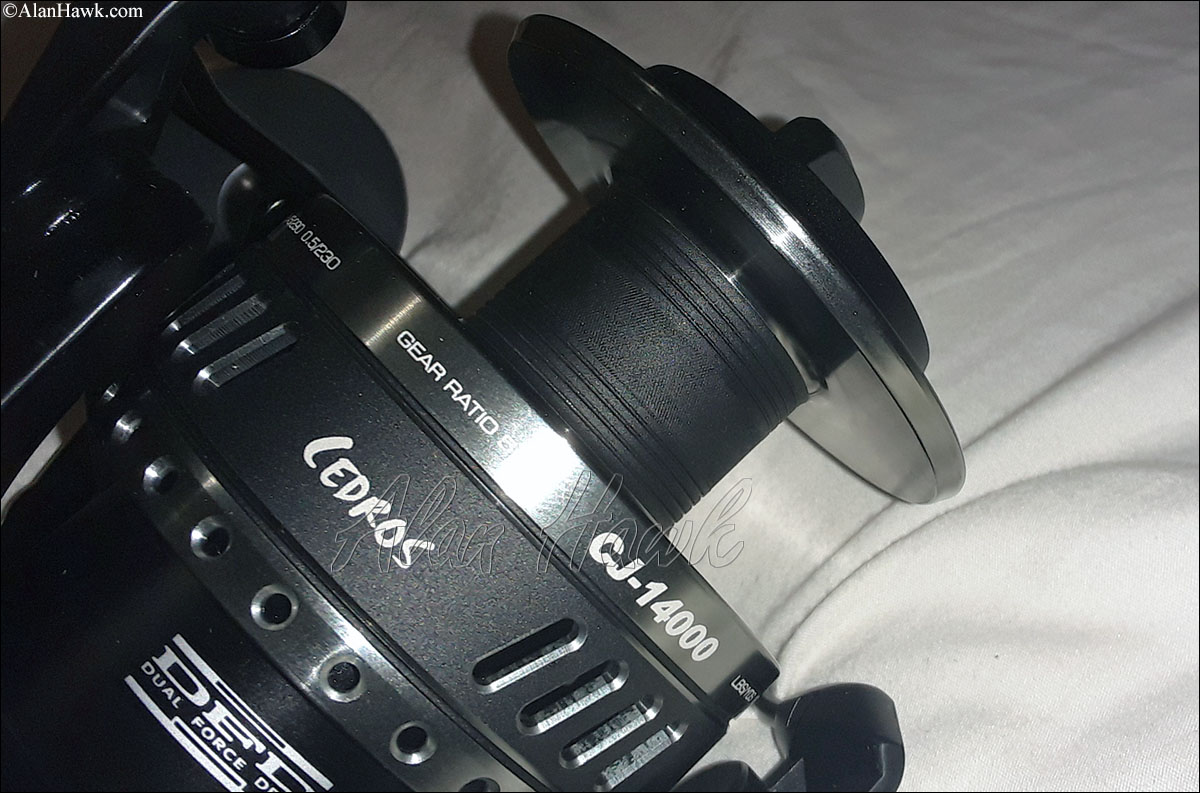
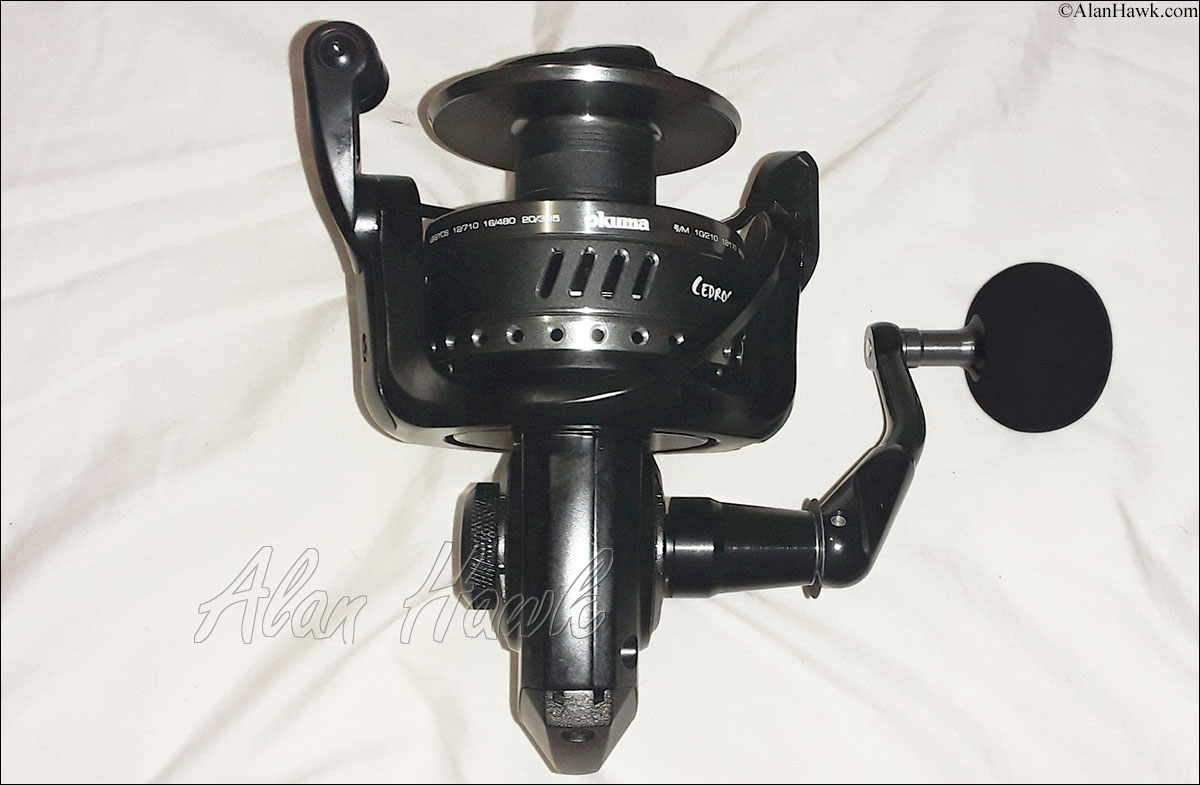
Dressed in black, with small silver highlights limited to the spool....
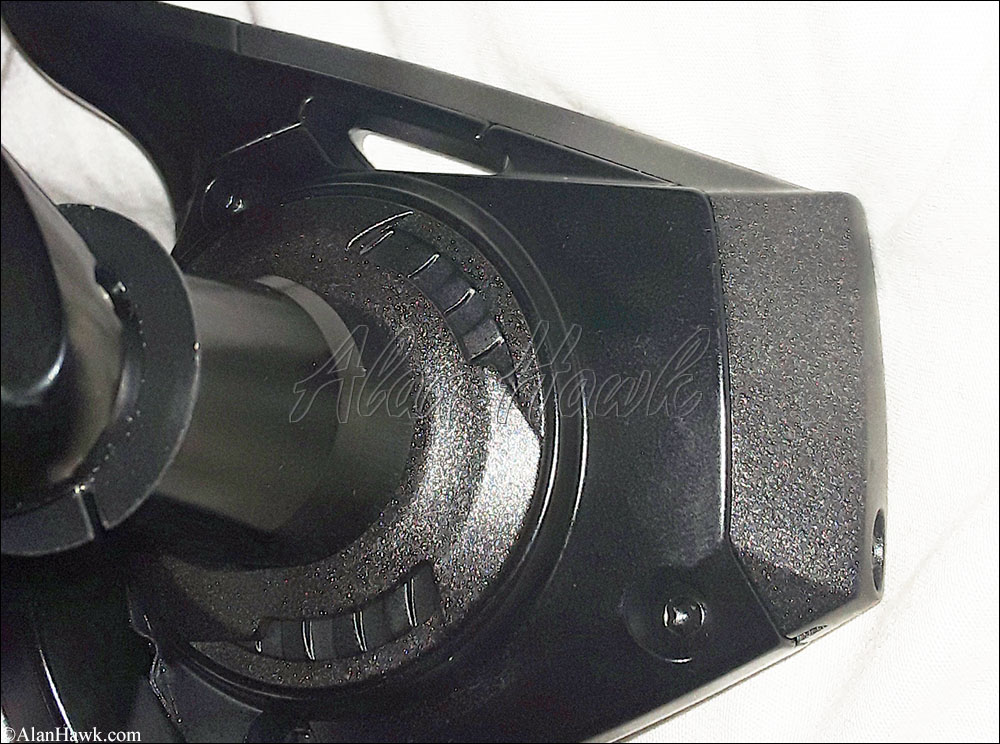
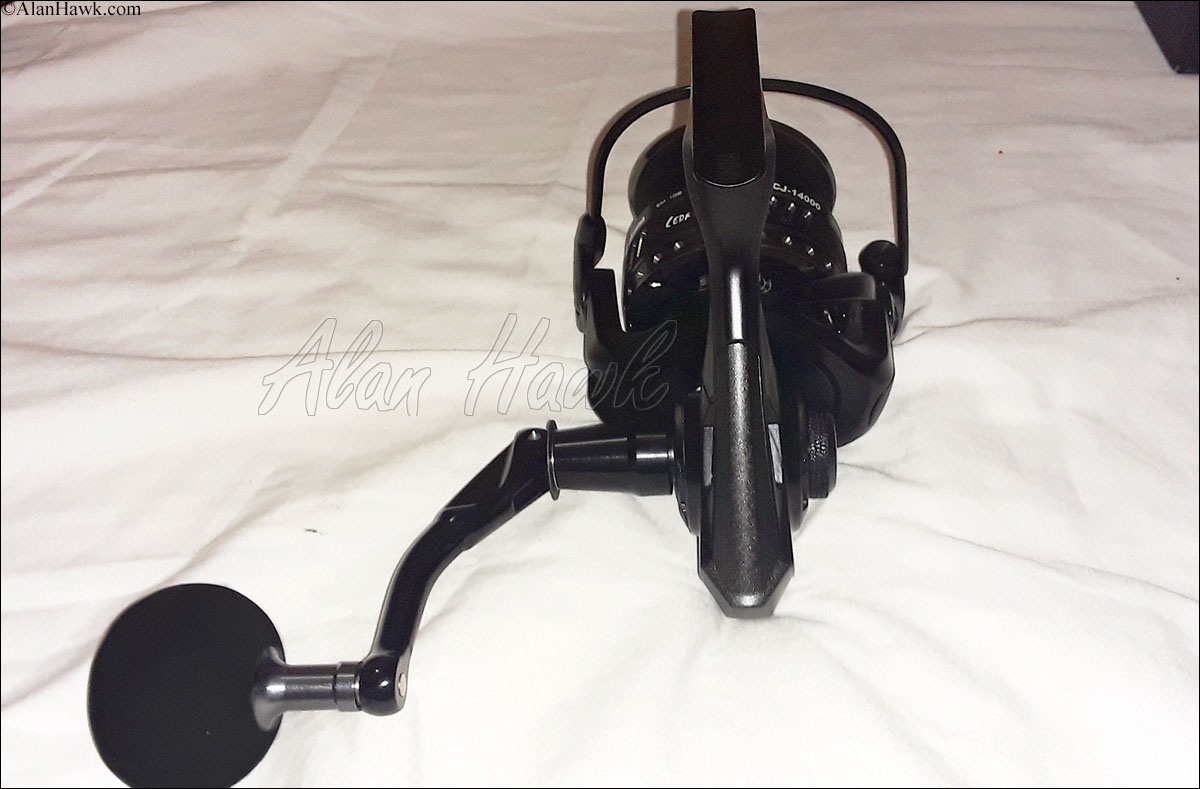
And small accents of dark grey on the rear body bumper and two ornamental inserts at the sides of the gearbox, all of which are made of plastic. Seen in this photo is the circular paper protector inserted in the handle's joint to protect it in transit, to be removed before use.
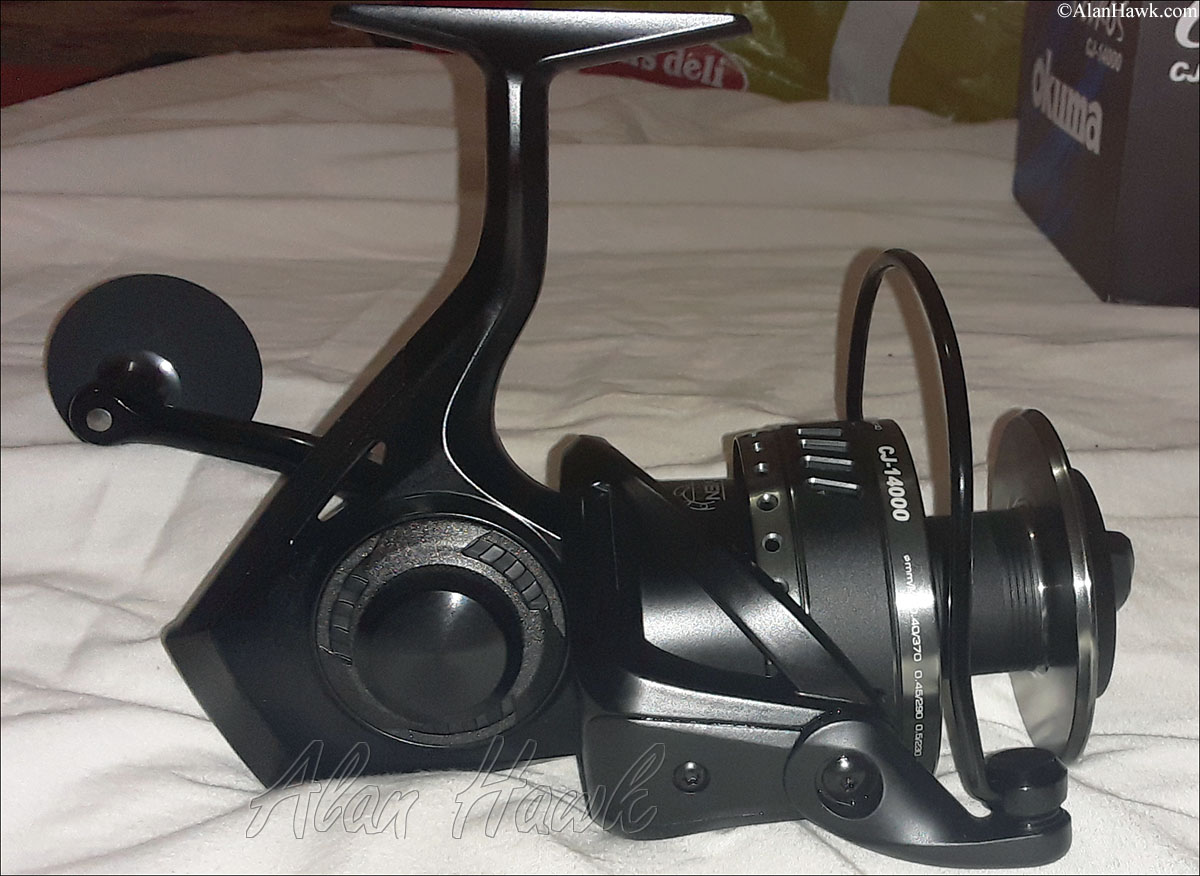
The distinct rotor with curved support limbs, each anchored to the centre of the rotor to provide reinforcement to each rotor arm, only on one side of each of these rotor arms. Back then this rotor shape was still relatively new and they hadn't even yet given it the corny name "Cyclonic Flow Rotor", now it has become a signature of Okuma and its own thing.
The black theme expands to the drag knob, its well, and even the bail wire is finished in black.
Two rows of weight-reduction porting in the spool's skirt, both fairly simple shapes of round cuts beneath leaning stadium/capsule ones.
The 2020 Cedros follows Okuma's currently prevailing aesthetic profile; minimalist gearbox with no more material than what is exactly required to encase the mechanism, incidentally giving it a handsomely slim profile from all directions, except the bottom where it looks slightly bloated. That gearbox, though, being actually boxy in shape with no embellishments to speak of, is optically dull and borders on boring. The rotor counters this effect slightly with its interesting branching support limbs, yet its flair clashes with the plainness of the gearbox effectively suppressing any suggestion of visual cohesion. Sometimes blending two visual identities creates a compelling contrast that works, other times it doesn't, and the Cedros certainly belongs in the latter group. The spool is as forgettable as it gets and lends no helping hand, for a trifecta that ultimately dooms the Cedros as an aesthetic failure consumed by disjointed blandness. Looks, nevertheless, are and will always remain a footnote of no consequence to a reel's worth, so let's move on to what one gets with the Cedros....
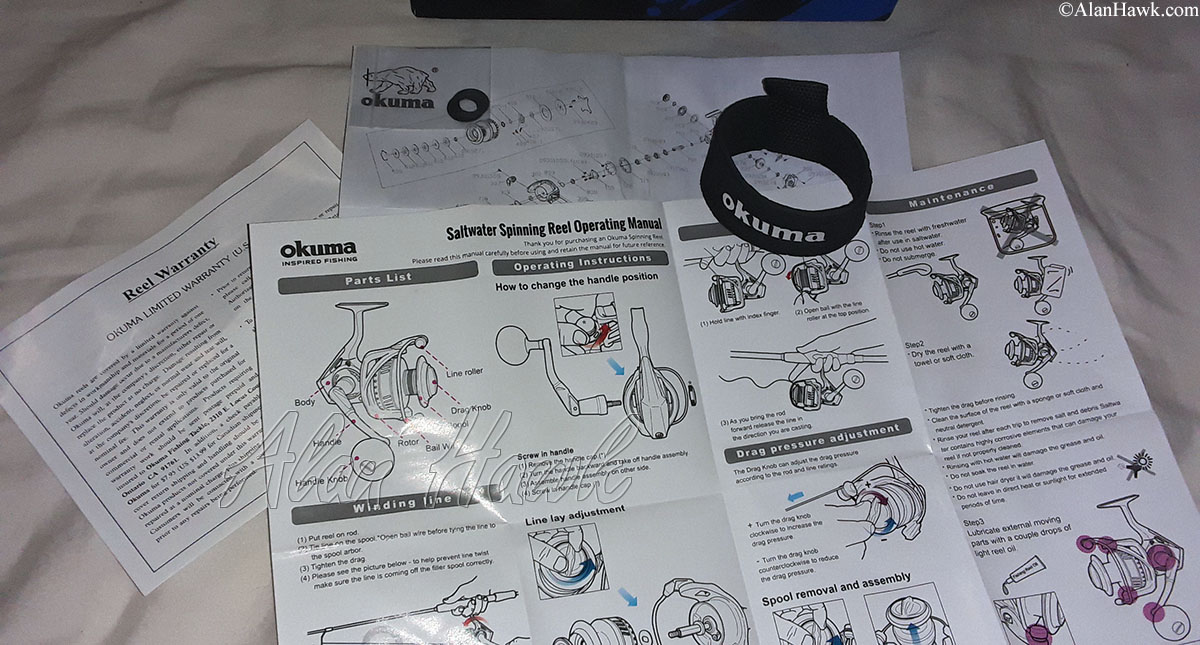
A spool band, a warranty paper, an instructions manual, a parts diagram, and a plastic bag with spool shims to tune the line lay, which sadly has been stapled to the parts diagram in Okuma's typical crude manner. They do this with all reels including even the flagship Makaira spinning, which is ineptly lazy. Why do I have to tear the corner of my parts diagram, or at best have two gaping holes in it, to free the shims?
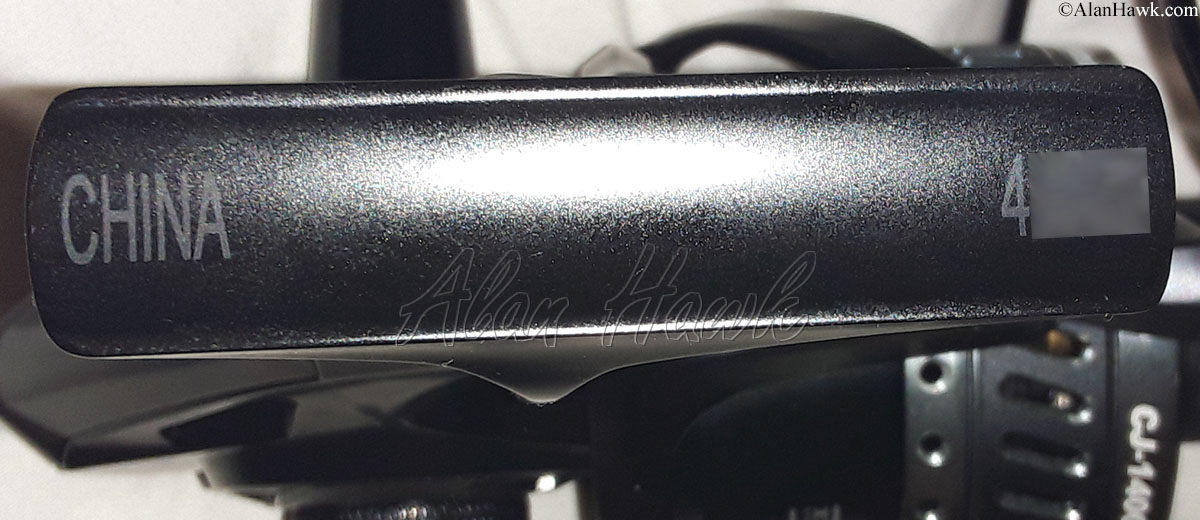
Made in Okuma's Chinese facility, and the number on the foot is not an individual serial number but instead a batch number shared with reels made during the same period with the same parts; almost every reel goes through design alterations during its production life, and a batch number on the reel enables service technicas to know its exact variant to either use parts corresponding to its batch or upgrade it to the latest specifications if feasible.
Right out of the box, the reel did this
The rotor has a large amount of back-play due to a design failure that afflicts a large number of Okuma models, something the brand seems completely disinterested in addressing. I spoke about this before, and even showed a video of this defect in reels that Okuma was exhibiting at a fishing show here (scroll to Okuma's booth). I got in touch with the shop that sold me this Cedros about the issue, they had one more left which they offered to send me as a replacement, but I told them to first unseal it and check the rotor, which they and it too had the defect. More on the technical details of this problem and its prevalence later on, but the fact that I haven't seen any attempts to fix it for several years is totally unacceptable.
Oh, on the embarrassing background music, back then I still thought she was just being cute and singing so I kept a couple of her tunes on the USB I listen to when driving or working out etc., fully unaware she'd begun telling us whom to vote for. Yeah right, because when I'm deciding my family's future and wellbeing I sure seek guidance from a barely-literate kid who probably thinks a capitalist is someone who comments on her Instagram posts in upper-case and if asked to define mercantilism would likely say "it's the hair style of the chick who ruled Germany". When someone's only qualification in life is standing on a stage shaking her butt, which, admittedly, is tighter than the tolerances of the best Japanese reels but still, she doesn't get to lecture anyone. And I'd say the same even if she supported the other side, because ultimately all sides are lying corrupt degenerates and voting has become a matter of picking filth just to stop the other filth who on top of filthiness tells little Timmy he's actually a Jenny inside. I initially considered removing the sound from the video, but it felt like a sort of deception and I decided to leave it as a snapshot of my naive self 6 years ago then explain it with one of my rambling digressions, which I just did!
Let's spool it
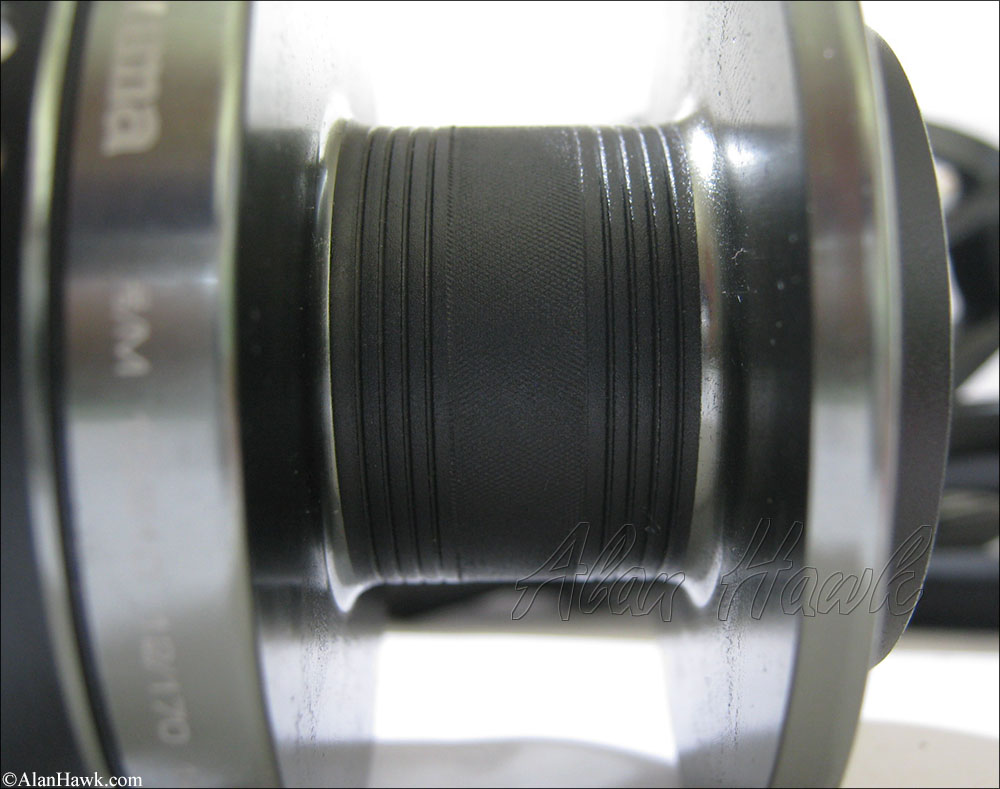
Spool's arbour has a knurled strip between two sets of machined rings, all topped with a slip-resistant black finish to give braid something to grip onto when tied directly to the spool. It works, but over the past few years I lost my indifference towards all braid-retention measures and began seeing them as infantilising gimmicks; if not made and finished to optimum standards or if the knot isn't perfect braid damage would occur, and they deprive the angler of the option to use adhesive tape since the glue gets embedded in the grooves and knurling becoming a nightmare to clean off. Just give me a plain surface and let me deal with it my way, I'm not a helpless child.
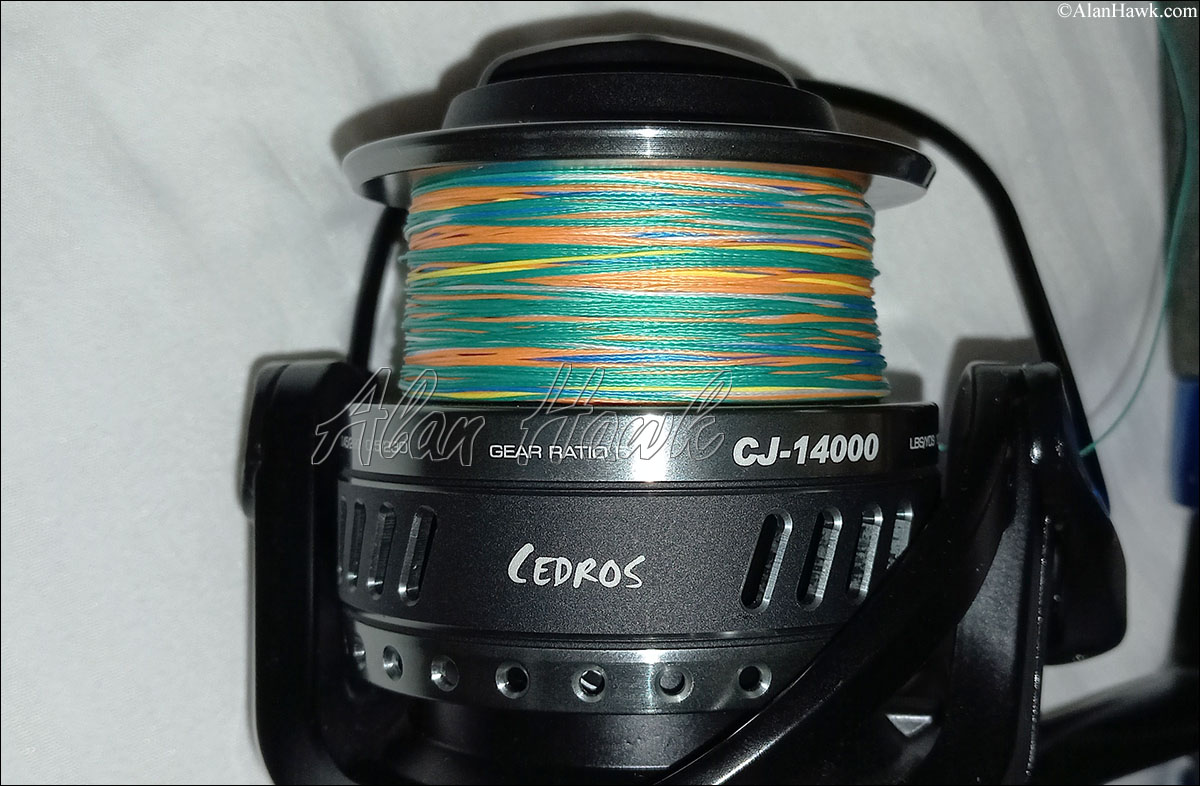
The Cedros was laying too much line towards the bottom of the spool forming a slight cone, which is a normal occurrence in all reels resulting from uncontrollable manufacturing tolerances in the many involved parts. That's what the little bags of spool shims often included with the reels are meant to address.
Since the line was piling up at the bottom, I removed one of the shims beneath the spool. Had it done the opposite, stacked too much line at the top, I'd have added a shim.
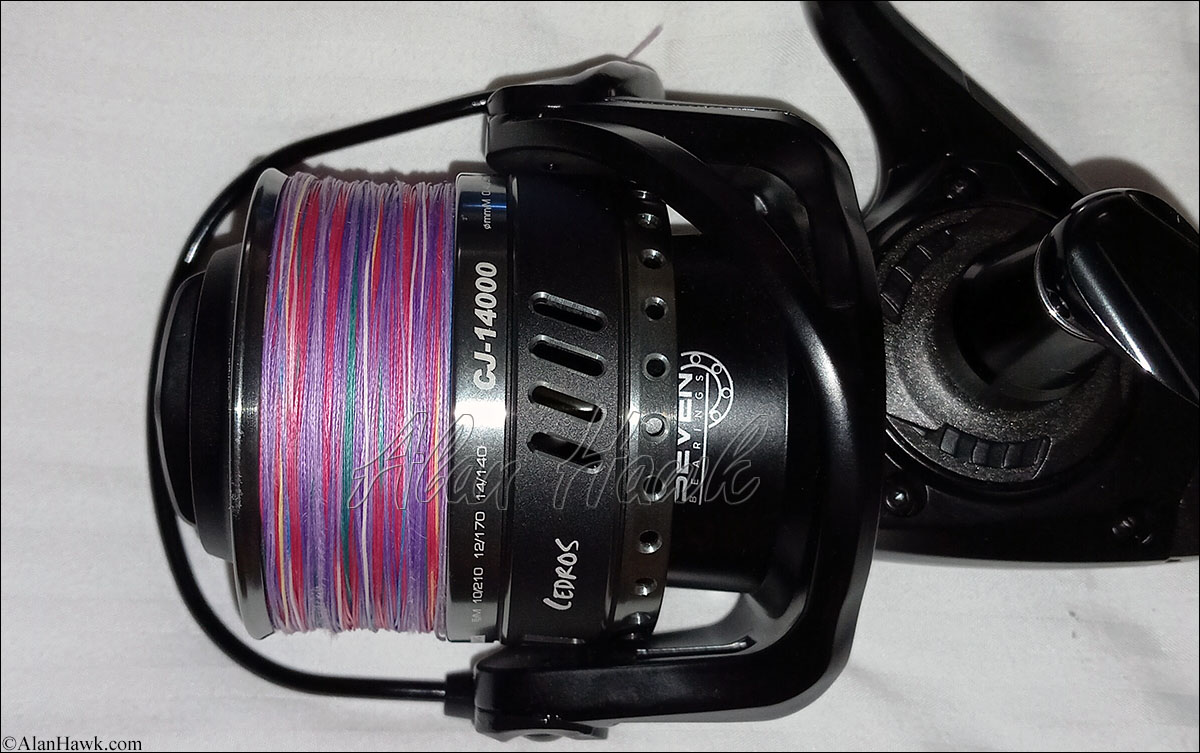
Re-spooled after tuning, lovely result, and a lay that's appropriate to the jobs this reel is to be tasked with.
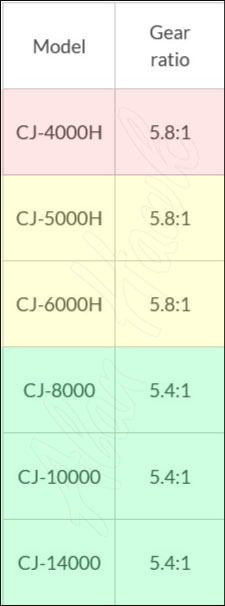
The 2020 Cedros is a dedicated saltwater series whose range is intended to cover light shore to medium inshore work and everything in between. It comes in three size classes, a "tiny" class represented only by the 4000, a "small" class made of the 5000 and 6000, and a medium class whose members are the 8000, 10000, and 14000. The 4000, 5000, and 6000 are "H" models (High gear ratio) with a 5.8:1 retrieve, while the 8000, 10000, and 14000 have no letter designating speed even though an "H" would've been appropriate for their 5.4:1 gear ratio. The 4000 shares the frame, gearing, and shaft with the 5000/6000, but it has a smaller rotor hence the split into its own size class. Not every model is available in every region, so you might not find all of these where you live.
The series debuted in 2020 at US $155 for the 4000 and climbing up to US $187 for the 14000, a weirdly specific number that's neither rounded down to 185 nor up to 190, now with inflation ravaging our worthless banknotes the price has increased to range from US $204 for the 4000 to US $242 for the 14000 at the time of writing in autumn 2026. Still strangely particular amounts. Street prices are measurably lower though and it's not difficult to get them now at only US $15 above 2020 prices.
The 2020 Cedros has a full metal build in all sizes, something that is becoming increasingly rare today from mainstream brands who've been increasingly using plastic for some major parts in many of their offerings short of premium models. There is nothing wrong with well designed and fabricated plastic parts as long as they do their job properly, yet the reassuring rigidity of a full metal build evokes memories of old school toughness even if it's no longer essential.
The Cedros went the whole nine yards with the "full metal build";
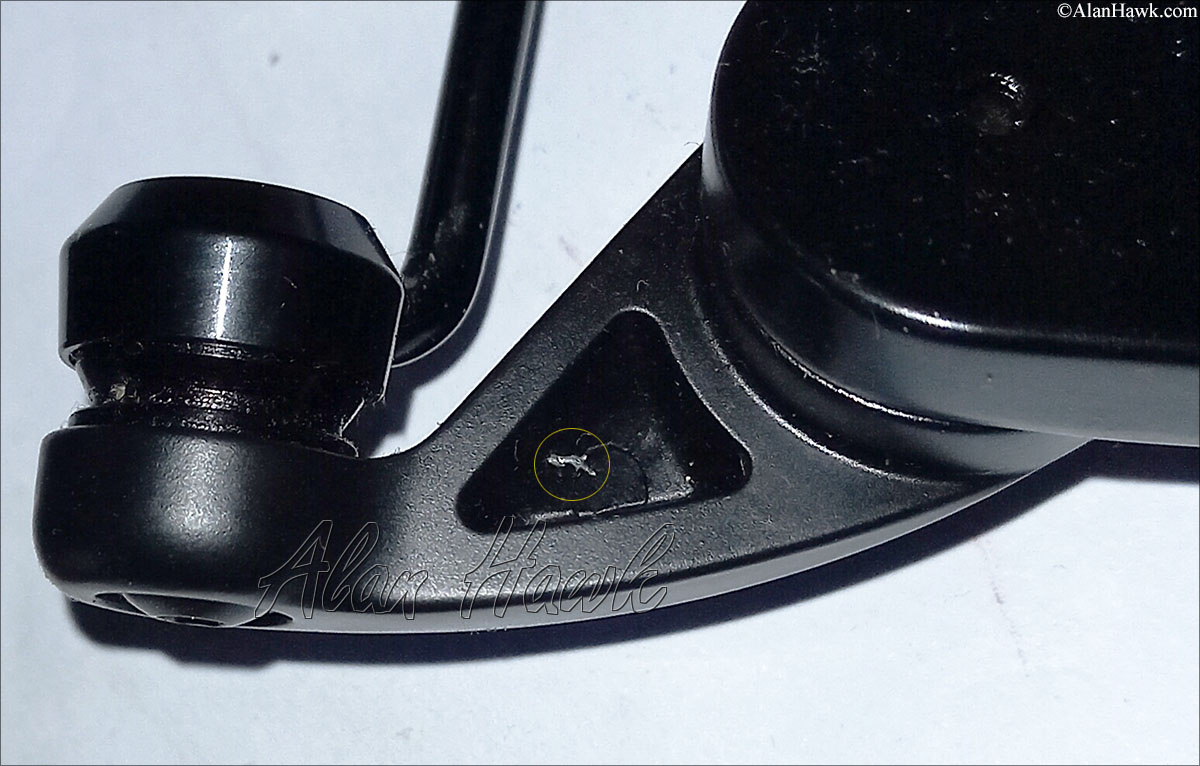
Even the bail arm is metal! I scratched the finish to show you. The Cedros goes for maximum stiffness throughout. Neat!
You'd probably expect this full metal series to weigh above average at the very least, but it actually doesn't. The 2020 Cedros is essentially the same weight as Daiwa's 2016 BG despite that Daiwa having a plastic rotor, and it's considerably lighter than Shimano's 2021 Spheros SW-A despite that Shimano having a plastic rotor and a plastic gearbox. Not only that, but this Cedros is hilariously even lighter than Okuma itself claims it to be; my 14000 coming at 642.5 grams (~22.7 oz) vs the advertised 646 grams (~22.8 oz), and I weighed a retail purchased production 8000 at 621 grams (~21.9 oz) which is lighter than its listed 624 grams (~22 oz). The difference is quite small, but when was the last time a reel weighed below what's claimed? All other sizes I examined were not retail bought production pieces so I'm not citing their weights.
How come it's this light?
Okuma flexed its industrial muscles researching and manufacturing a special alloy combining aluminium and magnesium, which they called "Litecast" and used to construct several reels including the 2020 Cedros, and . Adding magnesium to the aluminium alloy brings weight down while maintaining the rigidity of metal. Magnesium is known to be highly corrosive in saltwater environments, but in one of the endless wonders of metallurgy the introduction of magnesium into aluminium alloy makes the alloy slightly more resistant to corrosion. You read this right, not less, not equal, but actually more resistant to corrosion. Of course alloys vary widely based on percentages, manufacturing methods, and treatment, therefore this wouldn't be applicable in every instance of alloying these two, but broadly speaking and in our specific context it is true. The 2023 Salina is also made of this hybrid alloy, while the rest of the quintet is built of aluminium.
Not to veer too much, but you must now be wondering why then don't everyone use a similar aluminium-magnesium alloy to make their best reels, including Okuma itself who builds its flagship Makaira with aluminium alloy. The main reason is strength, because an aluminium/magnesium alloy is not as strong as a typical aluminium alloy. Additionally, casting this hybrid alloy is more difficult due to its susceptibility to oxidation and developing internal defects, if done economically or by a manufacturer who doesn't have Okuma's technical capabilities and resources. This makes the alloy an excellent match for a lower mid-range series like the 2020 Cedros, but not the best choice for heavier duty reels dependent on the sheer strength of an aluminium alloy.
While proofreading the previous two paragraphs it dawned on me that it's fortunate that I'm pointing out serious issues with this reel and other Okumas in this review, otherwise I'd sound as if I'm being paid by the brand to exalt it! Two things can simultaneously be true; Okuma is an industry giant who can produce incredible reels if they so desire, and, they apparently have no such desire judging by the questionable decisions they make such as the cumbersome "pre-set" drag knob of the Makaira, the unprotected line roller of the Tesoro, or their apparent disinterest is addressing rotor play-back in a number of models. It is what it is, though, and my job is to just fish the reels and report that weird stuff then everyone can make of it what they will.
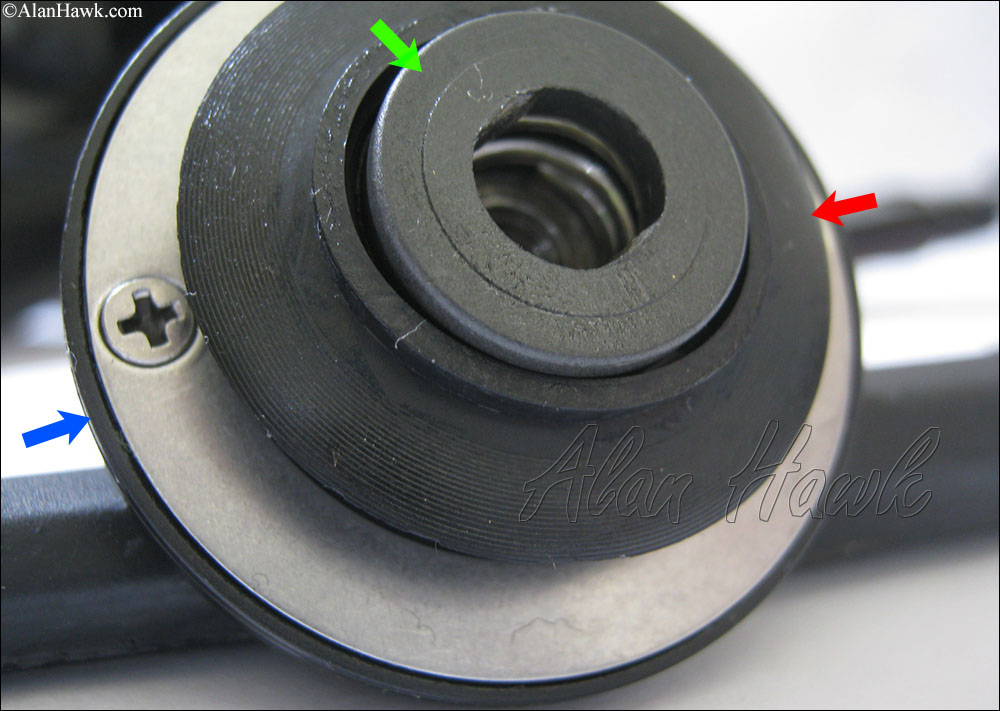
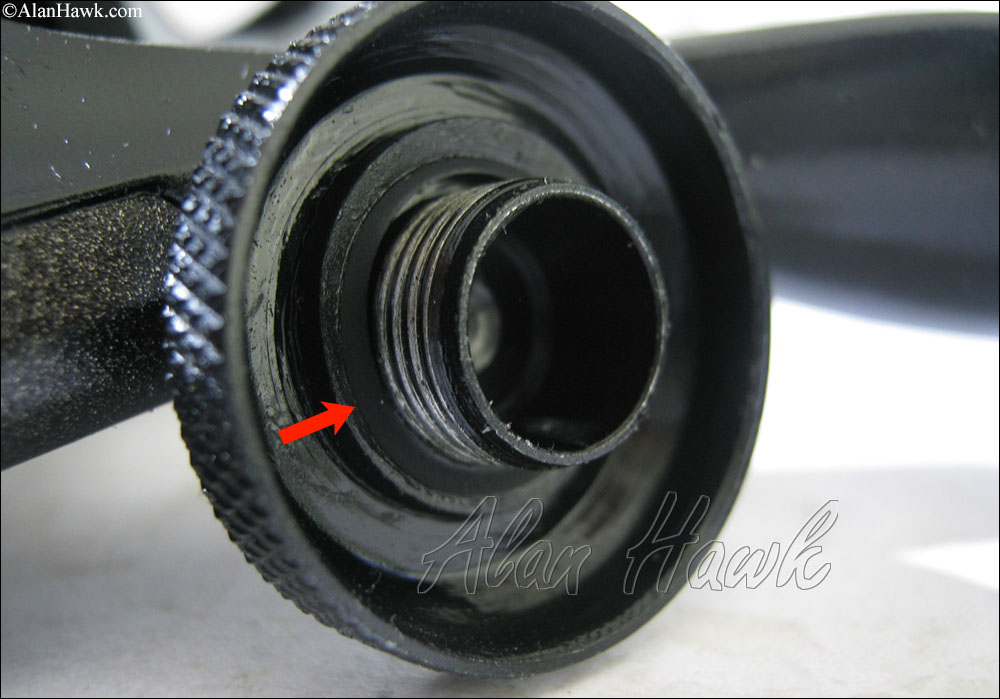
The drag knob has a plastic external casing (blue arrow) and a plastic pressure tube (green arrow), on which a rubber seal is mounted (red arrow) to protect the drag components in the top stack. This is a "deep-seal" type; a small seal that sinks into the drag well to protect its braking components, its size limiting its friction against the spool, but it leaves everything above it exposed to saltwater and necessitating an independent sealing to protect the internal mechanism of drag knob....
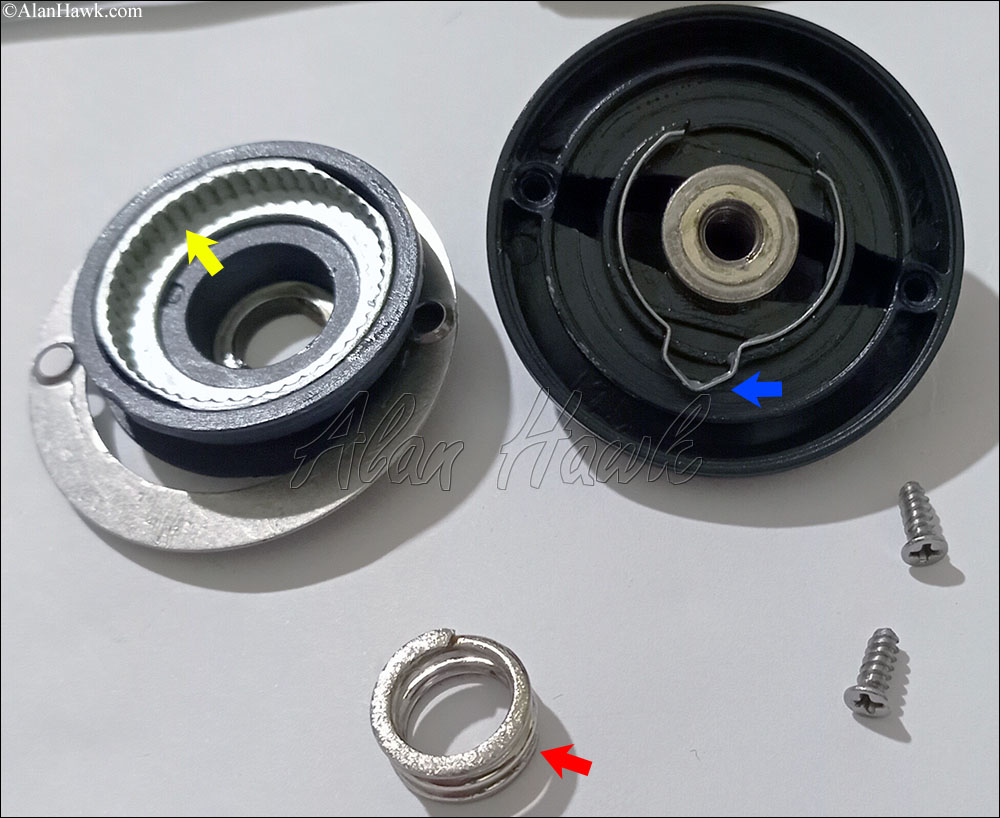
.... Which is not the case here. The knob's internals are not protected and saltwater can easily reach them if the reel gets too wet. Anyhow, the knob is powered by a regular coil spring (red arrow) and it has an internal clicker to help set it precisely by counting the clicks needed to raise or lower the pressure by a certain amount. That clicker is simple and reliable, made up of a pointed leaf spring (blue arrow) that slides across a ridged plate (yellow arrow) to create multiple stops that are both felt and heard.
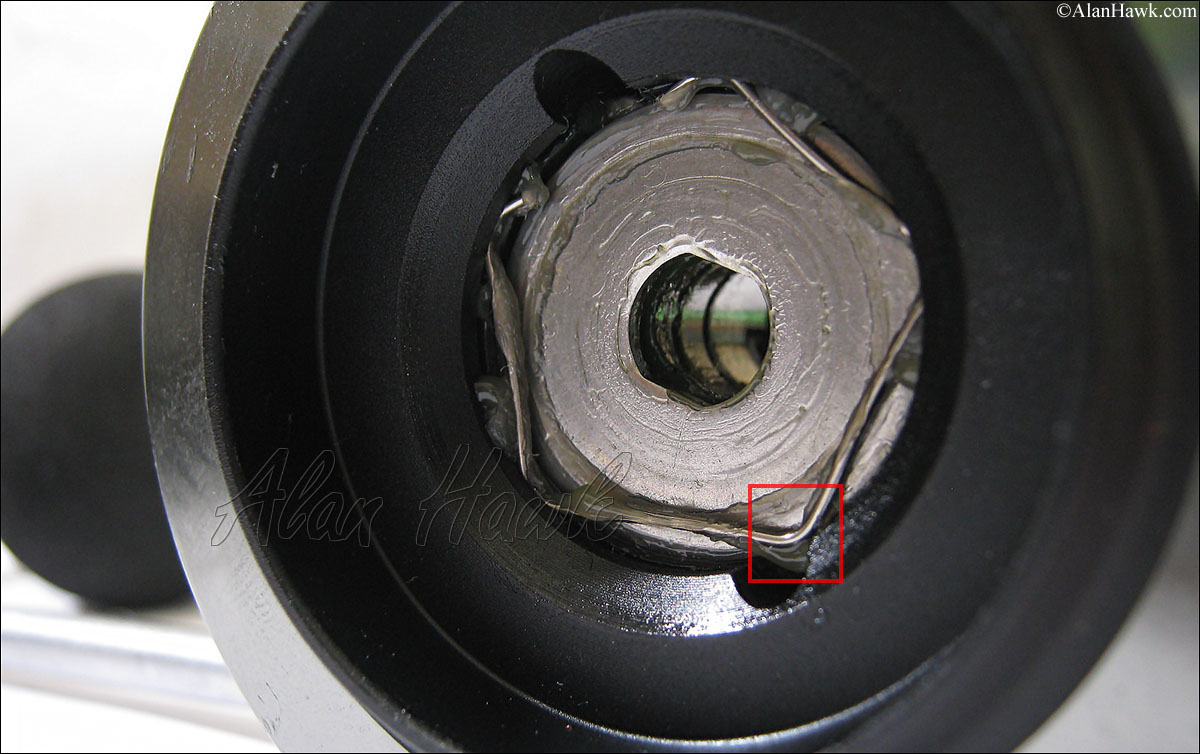
The wire retainer of the top drag stack is poorly made with one corner not even reaching the edge, which it should not only reach but also get securely embedded beneath it. One loose corner won't cause the drag components to pop out, nevertheless it's a defect.
The spool spins on a single bearing located at the top (blue arrow), and the brake washers of the top stack are made of felt (red arrows). This stack is the first part of Okuma's DFD (Dual Force Drag) feature....
And this is the second part of the "duality", a drag unit beneath the spool.
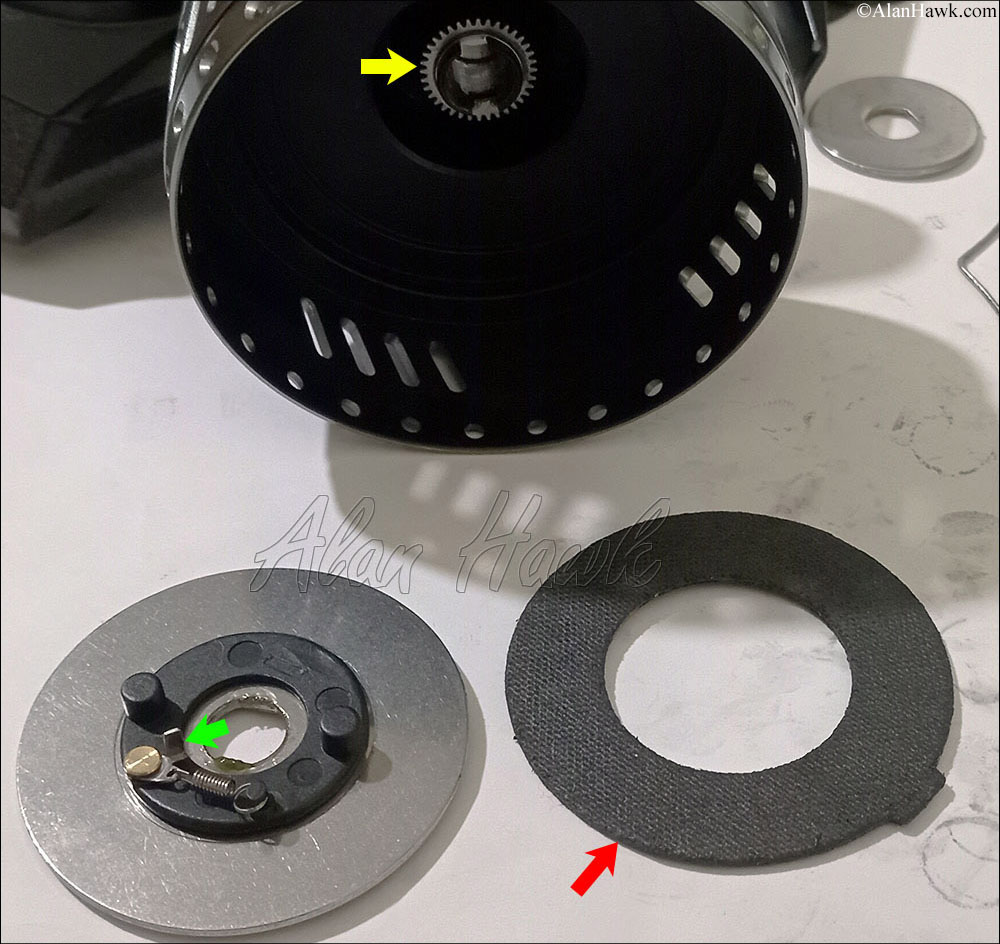
That bottom unit houses a single carbon fibre drag washer of a larger diameter than the spool's arbour (red arrow), as well as the drag clicker mechanism in which a striker that's powered by a coil spring (green arrow) slides across the teeth of a gear mounted on the spool (yellow arrow) to emit a buzzing sound.
That gear is held in place by another wire retainer, but this one is well fitting despite its much smaller scale. The sound of this drag is crisper than some popular comparable reels, and I'd describe its audibility as adequate; not exceptionally loud yet not faint by any definition and it should cut through normal shore/boat noise to get the angler's attention if he's not too far away.
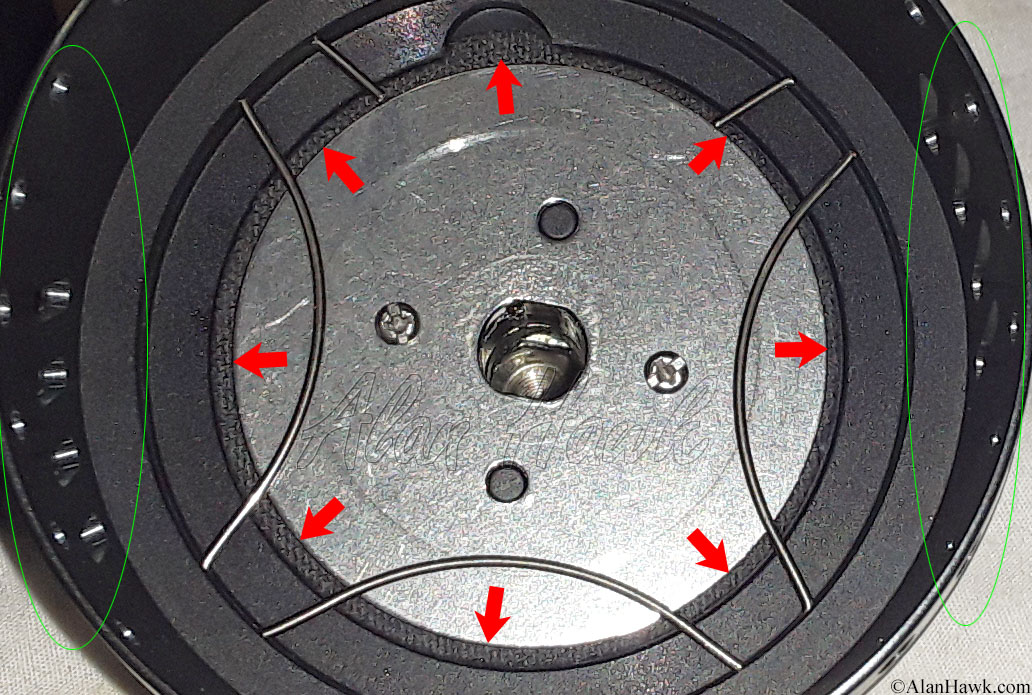
The bottom brake washer is keyed to the spool for a controlled uniform action where it can't slide against the spool's body and instead only slides against the metal cover plate....
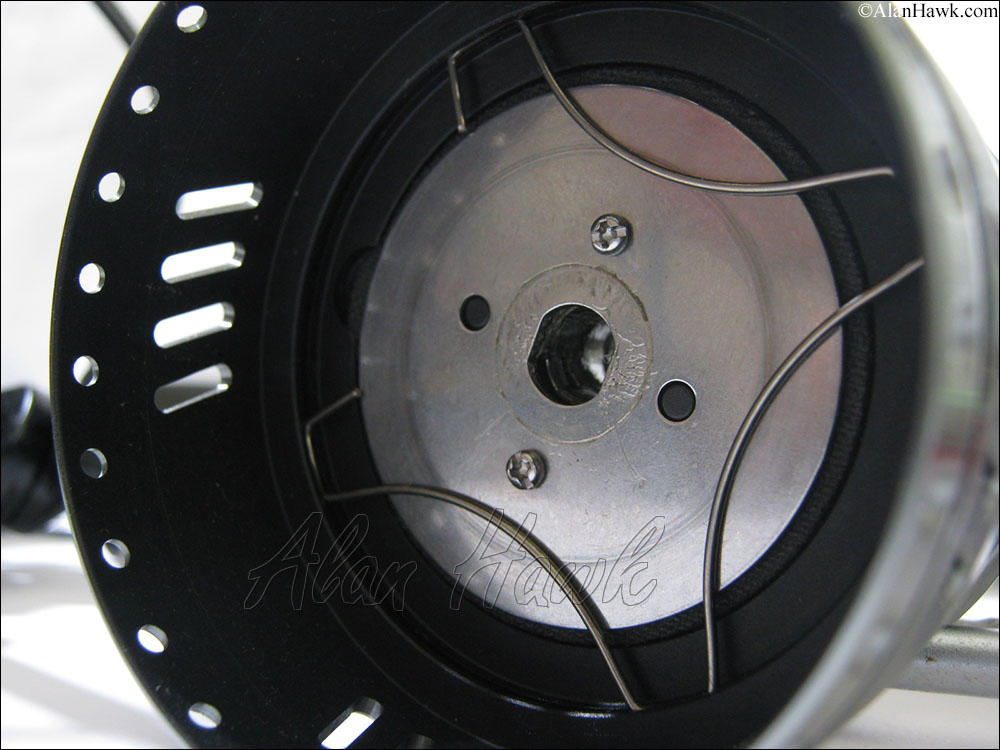
This cover plate, which, in such a serious blunder, doesn't cover the entire surface of the washer, both leaving a portion of its surface disused as well as exposing it to water that easily enters through the holes in the skirt (green circled). This essentially demotes the Cedros to one of the poorest protected saltwater spinning reel I've fished in the past decade and a half, and the other reels that were at this level of vulnerability to saltwater were almost half the price of the Cedros. I highly advise wrapping this reel in a cover during boat transit if placed in a gunnel, otherwise put it in a central holder away from spray when the boat is on the move. Being vertical in a gunnel doesn't spare it, because water will enter the skirt then once the reel is pointed down at the next fishing stop it will rush the exposed drag washer edges.
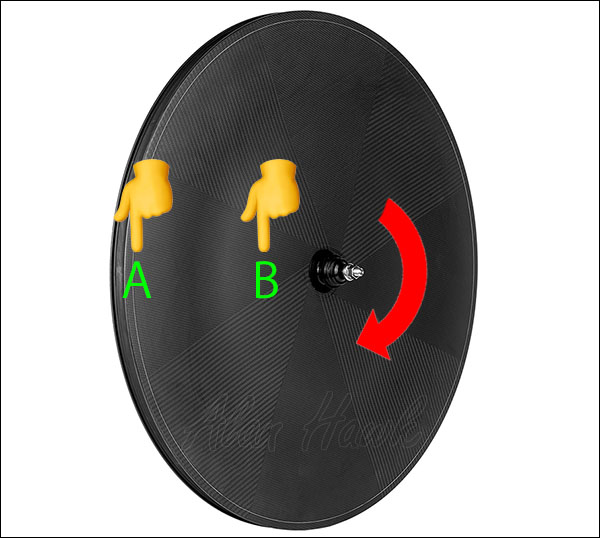
Generally speaking, large diameter drag components beneath the spool is one of the surest ways to create a capable high performance drag. The setup has its drawbacks, like weight, complexity, and spool position change when washers beneath it wear out or compress, but these are often outweighed by its advantages such as increased braking surface, faster heat dissipation, as well as its relaxed smooth operation thanks to the elevated leverage it has on the spool since it brakes it farther away from the axle of rotation, essentially the same reason you'd intuitively choose to stop the rotating disc in the following figure by engaging it at point A instead of point B;
On paper, the drag of the Cedros looks flawless, something that tens and of videos and reviews have asserted for the past 6 years merely by pointing at its design. I keep you waiting, though, because instead of assumptions I fish the reels then give you realities that might differ to what design theories suggest, which is exactly what happened with the 2020 Cedros; despite the promising drag build, it's always had describable stickiness whenever the spool began turning, which only became more prominent as the drag was set to higher pressures. Commonly known as drag spike, it's a phenomenon that causes the spool to remain still even after the line had been pulled with higher force than the drag had been set to, and as the pull increases in force the spool finally breaks free from its sticky stillness and starts spinning then it keeps going by just the lower amount of force the drag was originally set to.
When the reel was still new that stickiness wasn't intolerable, more in line with a large swath of spinning reels made until the late 1990s, but as time passed and the reel was fished more, this happened;
The sticky start morphed into a full on stuttering in drag operation in all phases of its running, still or mobile. As always I power through issues and continue fishing because I'm supposed to test a reel in its original state, but the drag got so bad the Cedros became almost unusable, so much so that continuing to fish it required me to loosen the drag to an almost "free spool" state then use my finger or palm to act as a brake, which was utterly torturous. Not doing that meant that fish were lost due to spool not starting or starting then abruptly stopping, etc.
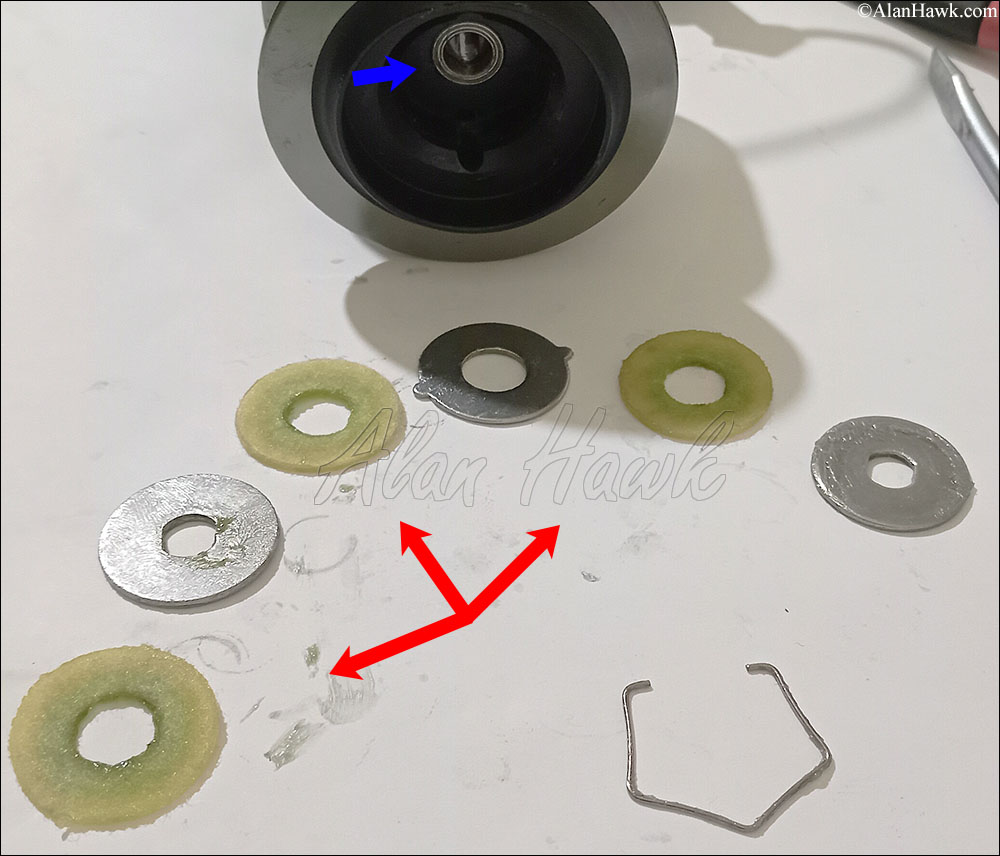
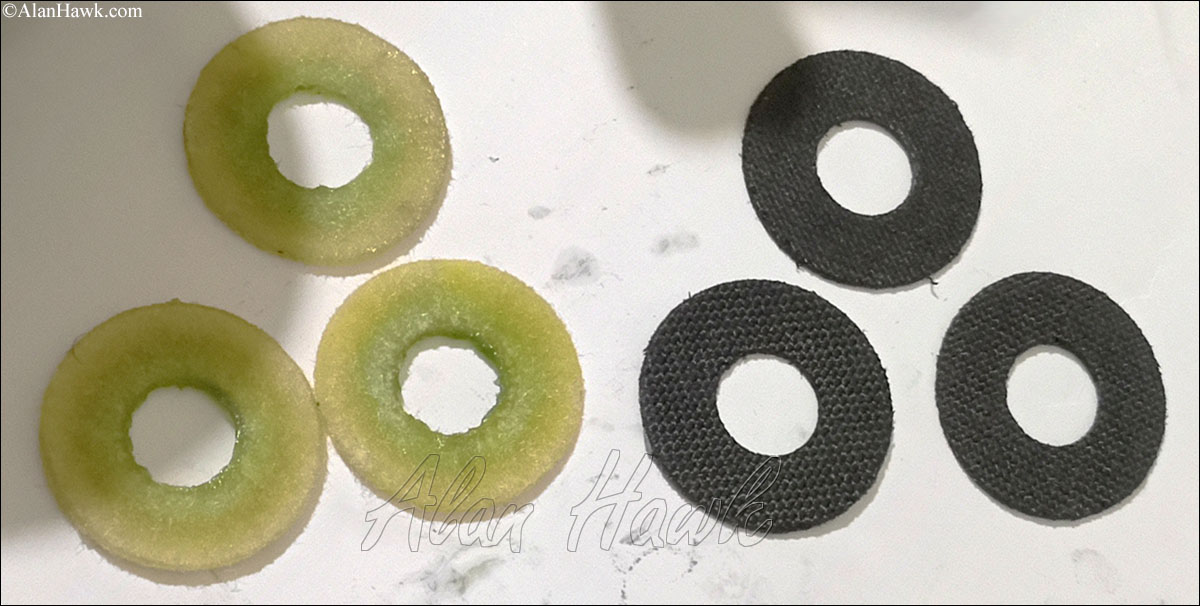
The culprit was the felt washers, which performed acceptably when new, but dried up and degraded with use. I had to choose either to oil the felt frequently to keep it in usable condition, or do a custom upgrade and get it over with....
And I went with the latter; found three carbon fibre washers in my broken reels' drawer and swapped them for the felt ones, after trimming their outer circumference to get them to fit. I kept them dry without drag grease, which is conducive to spike reduction, something this reel was in a desperate need for. The drag then worked very well, and even the initial mild spike was reduced to what I would consider the norm for a modern reel of this class.
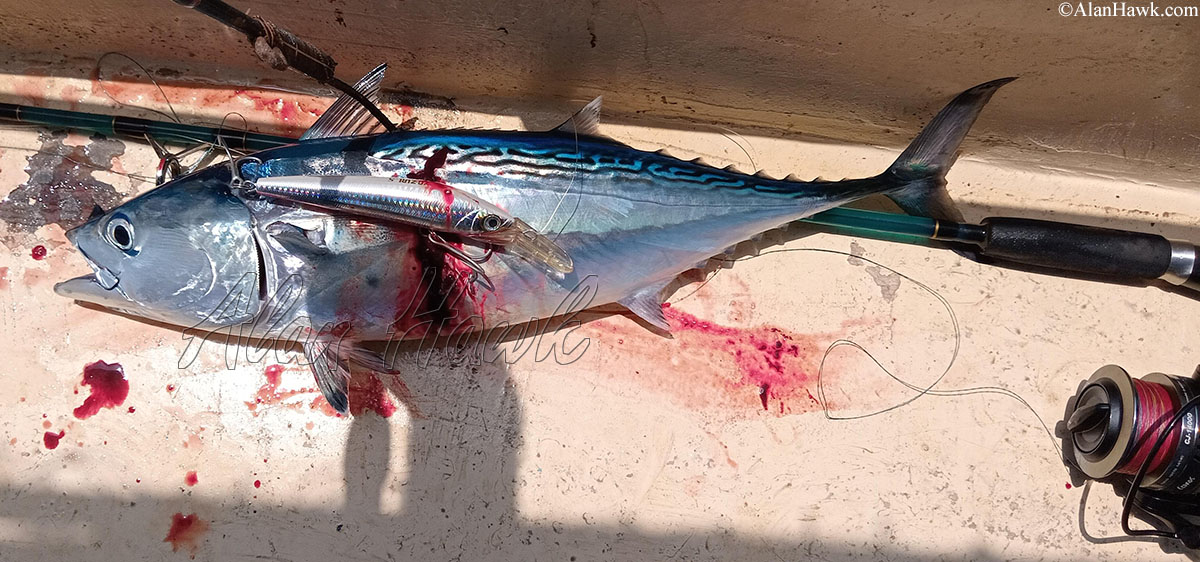
And just so no one thinks I abused the original drag by going after fish that's too big for such a lower mid-tier reel, this is a good representative of the size the Cedros typically landed, in this instance caught on a surface lure which is what this reel is more suited for with its high gear ratio. I did not subject this reel to anything that's out of bounds.
I don't believe Okuma was saving money by installing felt washers in the top stack. Rather I think they wanted to mix the unmatched smoothness of felt at the top with the relatively coarser feel of carbon fibre at the bottom for a potentially new drag feel that's somehow in the middle, but it just didn't produce a good result in this reel. The original Cedros of 2010 had felt washers both top and bottom of the spool, for the 2020 model they kept the felt at the top, now it's time to completely abandon this felt experiment and confine it to small freshwater reels.
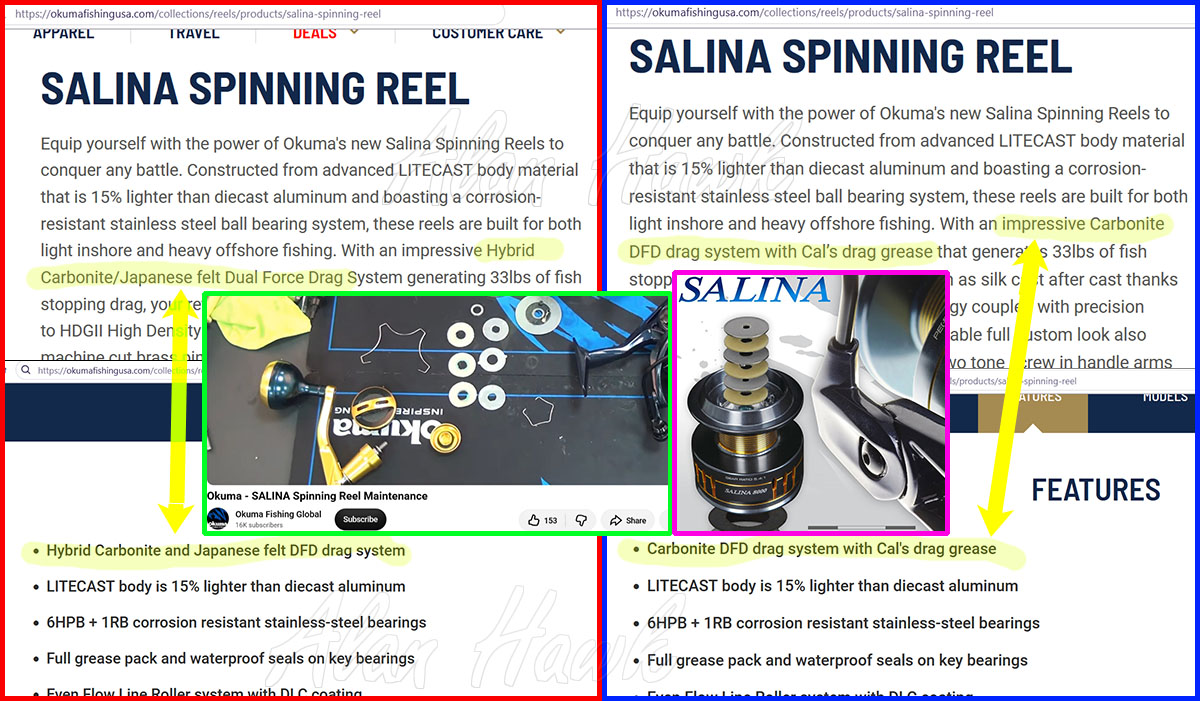
This leads us to the one and only meaningful difference between the reels of the quintet; this carbon and felt drag is found in the 2020 Cedros, the 2019 Azores, and the 2024 Azores XP, while the 2019 Metaloid has full carbon drag washers up and down just like my custom upgrade. Similarly, the current 2023 Salina has a full carbon drag top and bottom, but with a big caveat:
Press releases, exhibition information, shops' listings, and even Okuma official USA site stated that the 2023 Salina was going to come with the familiar carbon + felt mixture when it was first listed around spring 2023 (red square). Additionally, Okuma's own channel featured a Salina with felt drag washers at the top in a service tutorial (green inset), and they sent out promotional graphics showing an 8000 spool with felt washers (purple inset). Then, sometime around autumn 2023 they quietly changed the design to a full carbon drag up and down, editing the listing on their site to reflect this (blue square).
This means that an unknown number of the 2023 Salinas were built with the original carbon + felt specifications for a period in 2023, and while more than 3 years on it's quite unlikely that you'd stumble across one, I still had to tell you about it for the sake of the usual comprehensiveness of these reviews. I sourced a loaner Salina to evaluate a while ago, a 6000HA, and it had an all carbon fibre drag so I wouldn't worry about it too much at this stage. Anyhow, back to the Cedros....
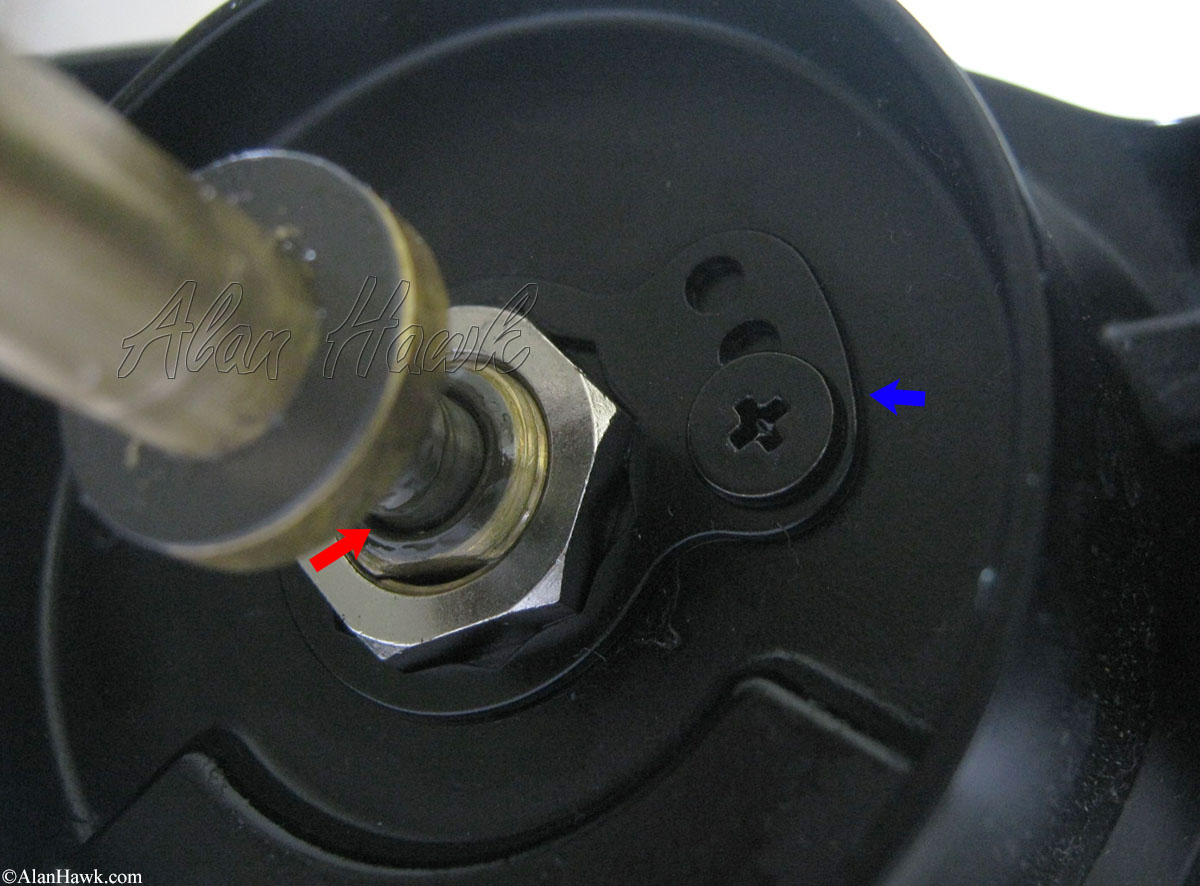
The rotor nut is a standard open one, not even the closed top type, and there is nothing whatsoever that would hinder water's entry into the pinion assembly (red arrow). On the positive side of things, the nut has a decent retainer preventing it from becoming loose, with 3 fastening holes for flexible nut positioning during reassembly.
Before these could come out the spool hub needs to go first
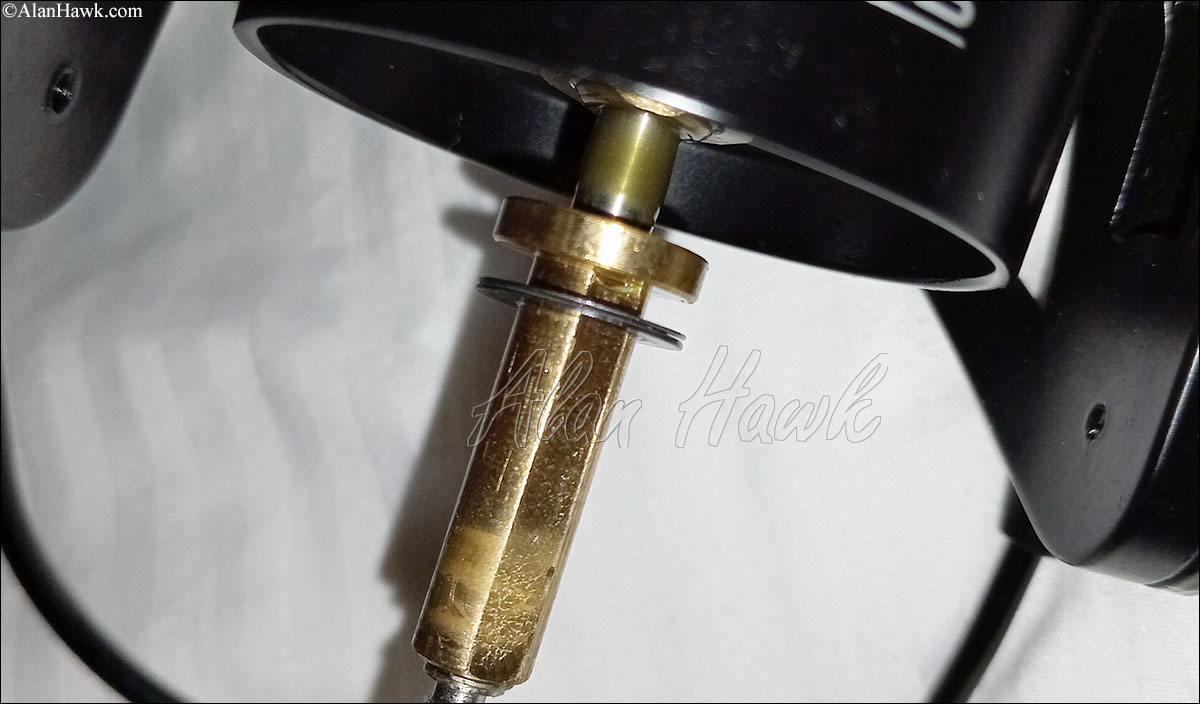
That heavy duty brass spool hub is held in place by a precise snap retainer....
Off it goes, bearing only light sheen marks near its top made by drag components spinning around it during years of fishing. A very durable part.
Rotor out, allowing a fuller look at its architecture. The Salina has this "cyclonic flow" rotor as well, while the Metaloid and two Azores reels have rotors of standard shape.
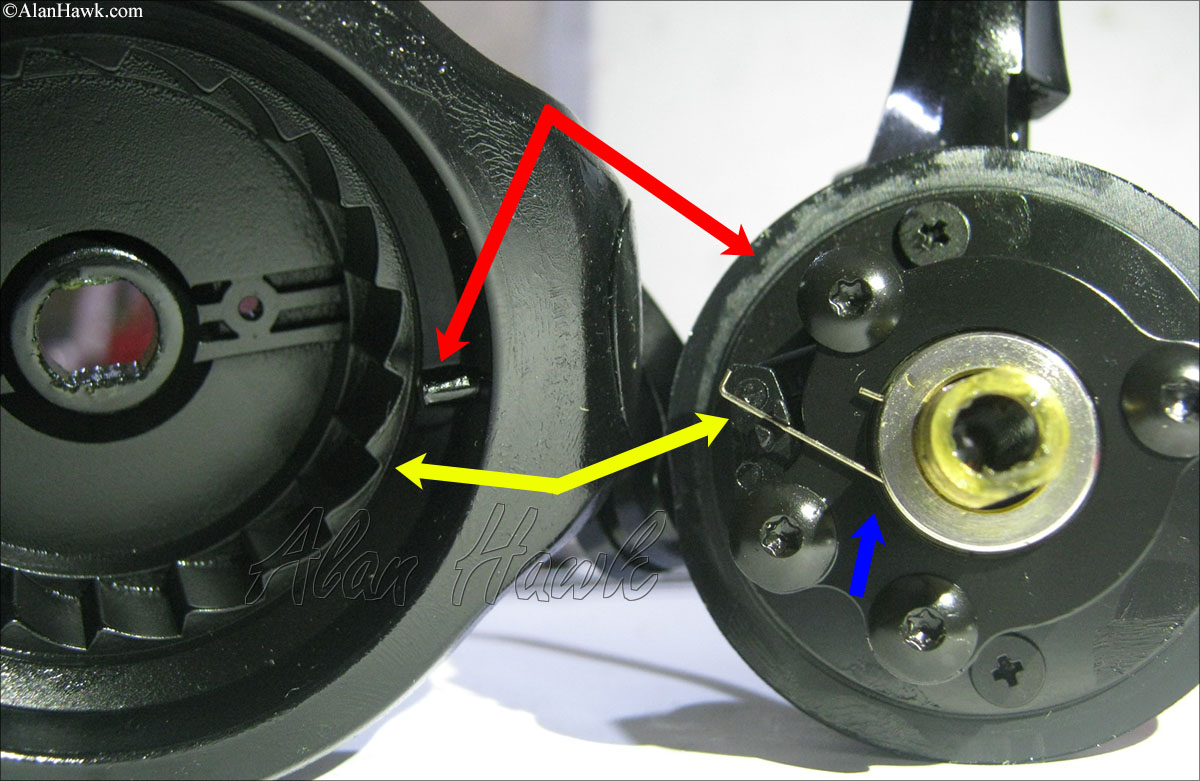
When the bail is opened for a cast, a lever at the back of the rotor comes down to engage a rubber disc on the frame's flange (red arrows), stopping the rotor from spinning during casting. All sizes of the Cedros have this rotor brake, which is welcome but not essential in 8000 to 14000 sizes whose bails are manually closed, while vital in 4000 to 6000 which have automatic bail closure that, absent this brake, might cause the bail to snap shut during a cast if the rotor spins and hits the closing ramp.
Still in the above photo, my reel has a mechanical backup anti-reverse that activates if the one-way clutch ever fails or slips due to such causes as wear, extremely cold weather, or contamination; if the clutch fails and the pinion spins in the wrong direction, a wire mounted on it (blue arrow) pushes out a plastic pawl to engage teeth cast into the back of the rotor (yellow arrows) to stop the reverse rotation of the rotor. This allows the reel to land the fish and continue working with what's essentially an old style ratchet anti-reverse until one gets to fix the clutch. Not all 2020 Cedros sizes have it, only 8000 to 14000 do. If you've been here for a while you'd know that I view this setup as a silly toy with a substantial potential to fail if ever put to a serious test, probably even causing jamming and/or finish damage.
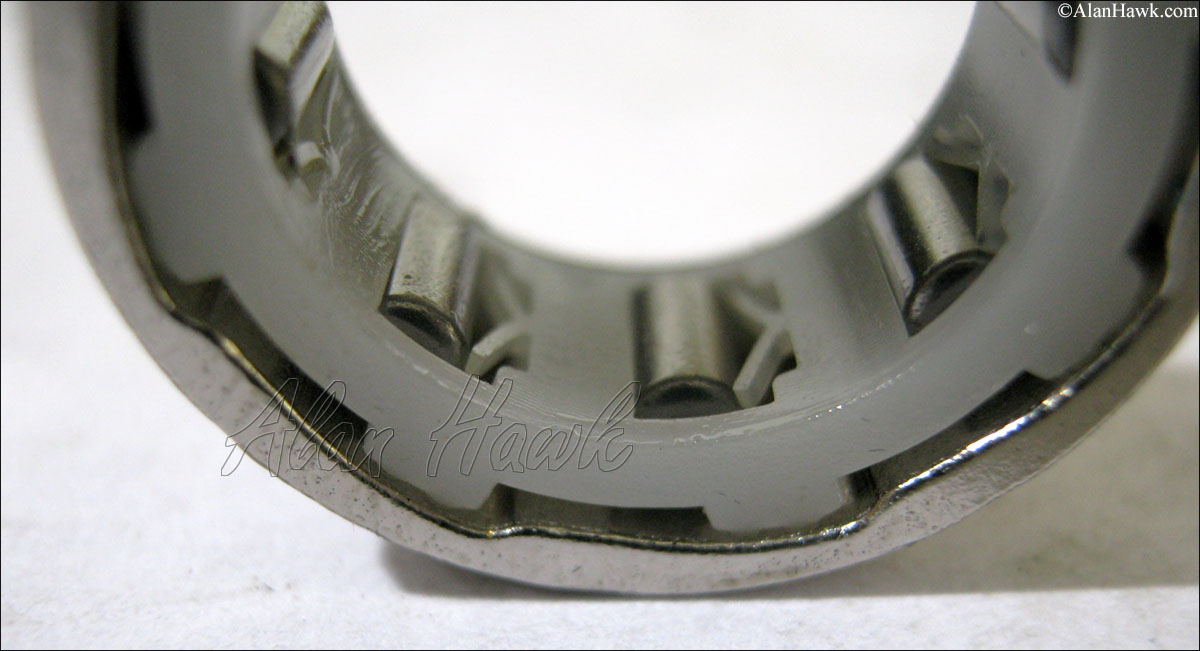
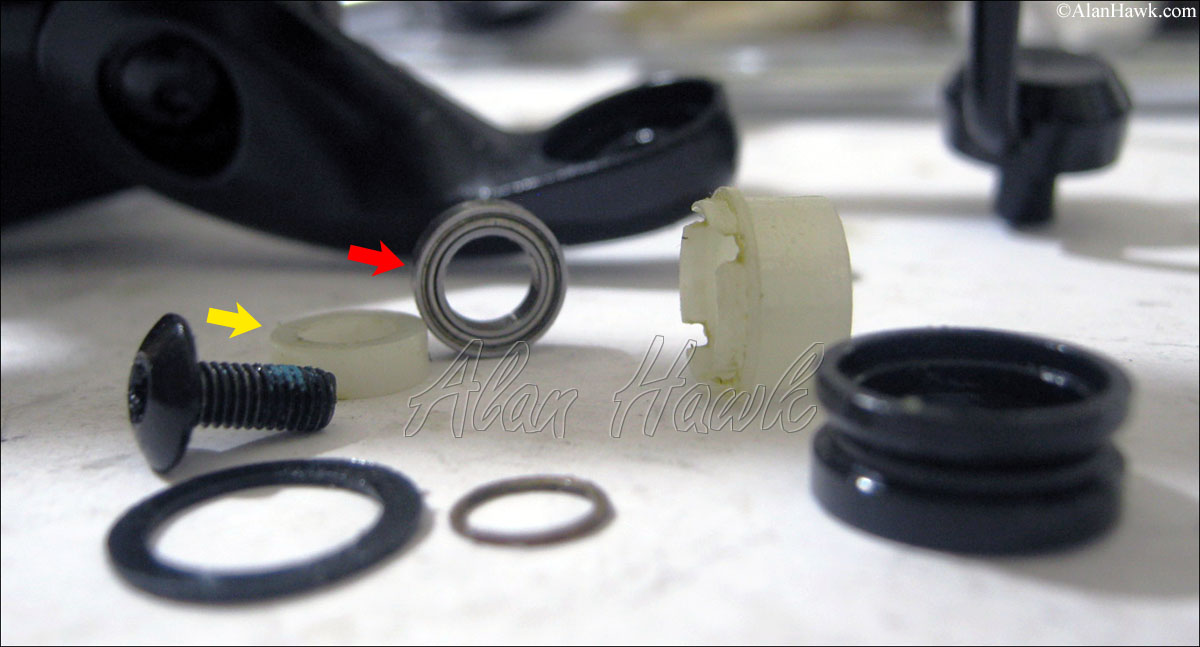
Pulling out the synthetic disc that snugly houses the top ball bearing of the pinion. That ball bearing has standard metal shields, which isn't noteworthy in most cases, but a reel that has almost no protection against water entry from the rotor's side like the Cedros could've gained considerably in this regard by the simple employment of sealed bearings.
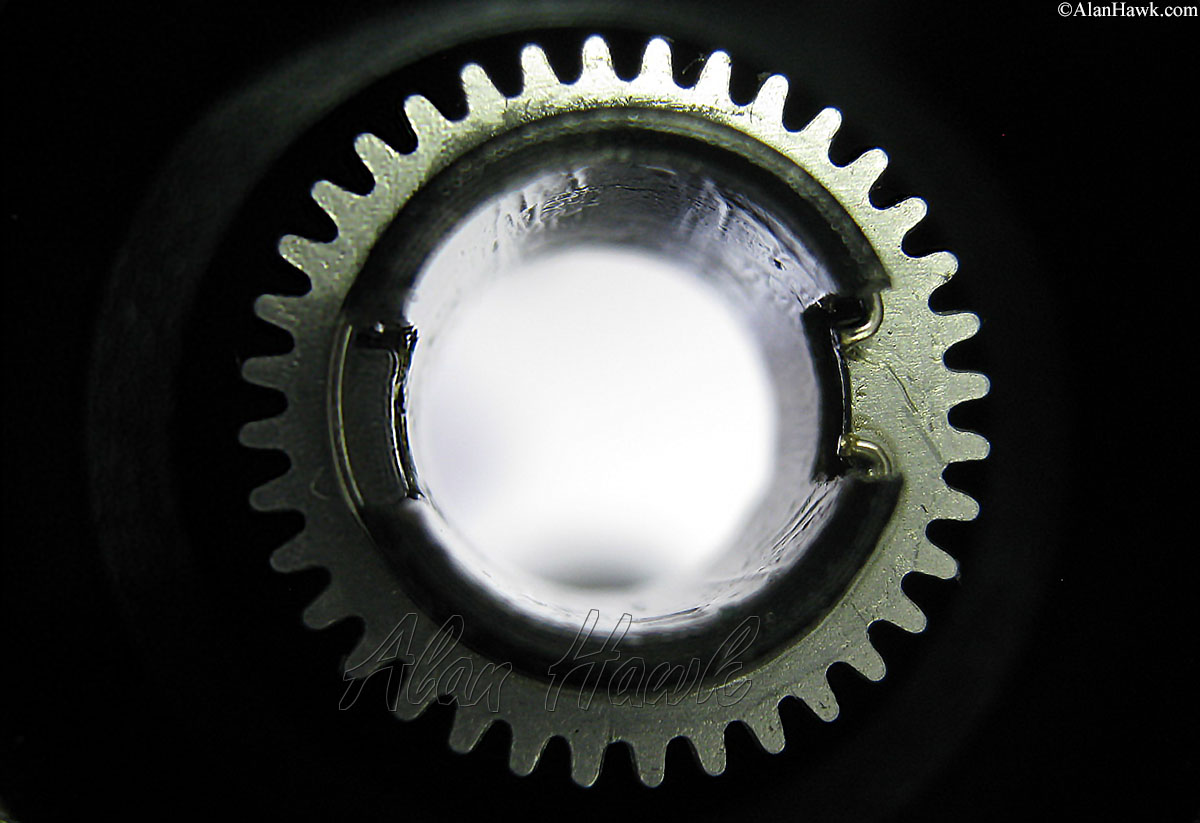
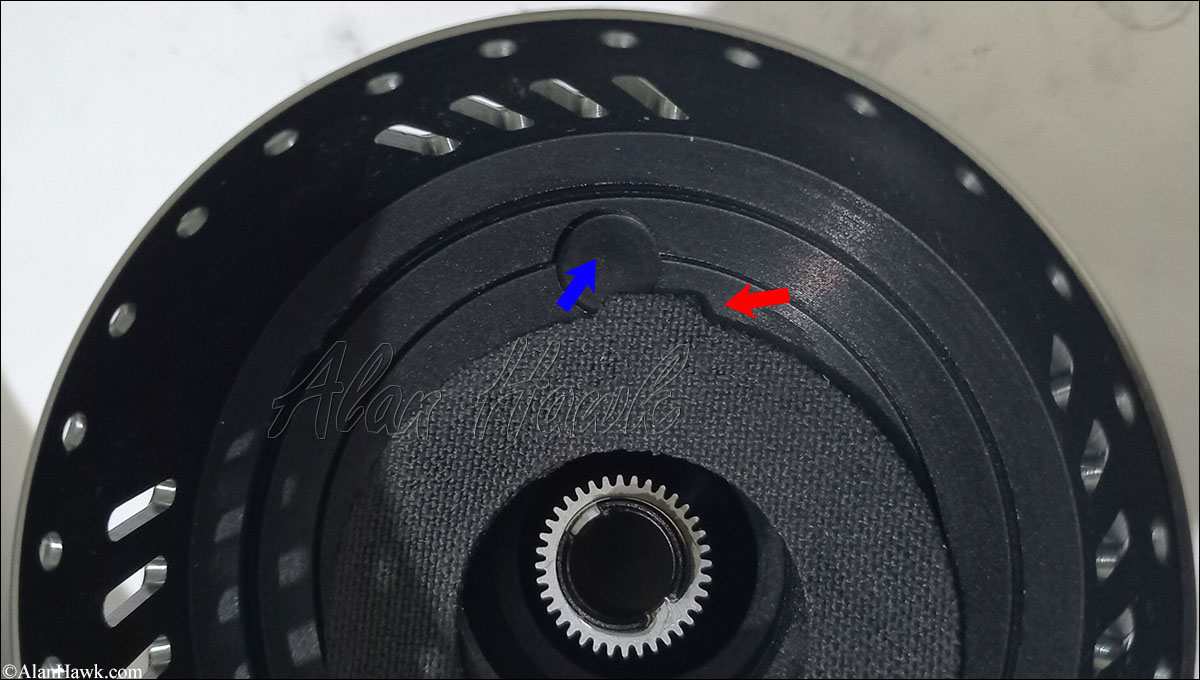
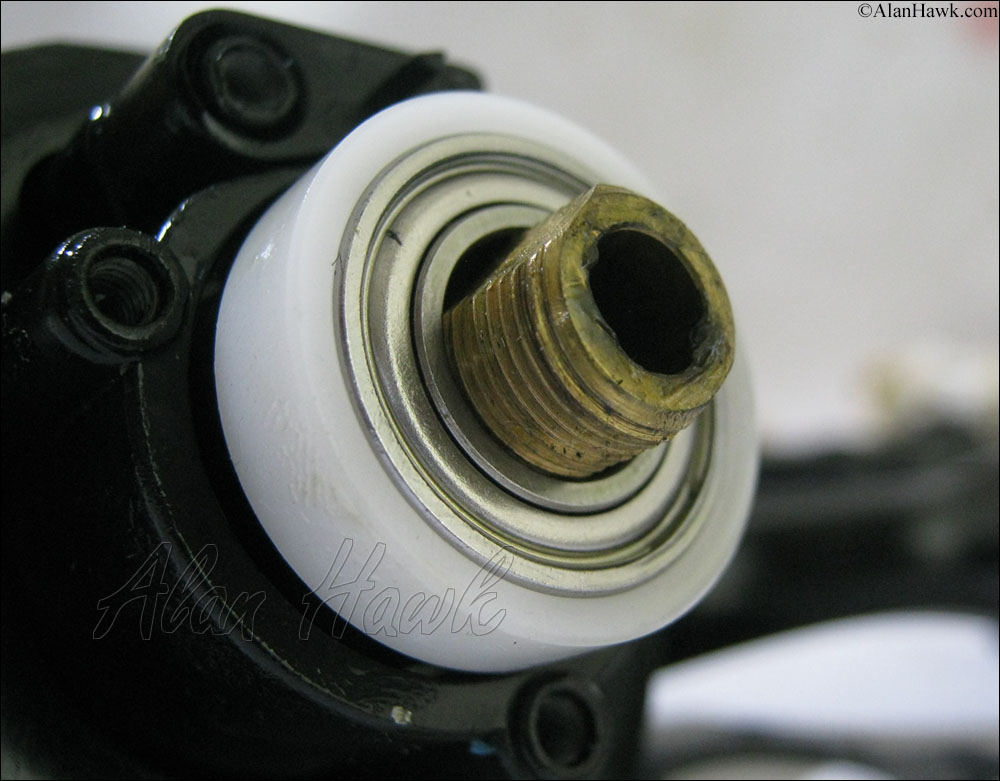
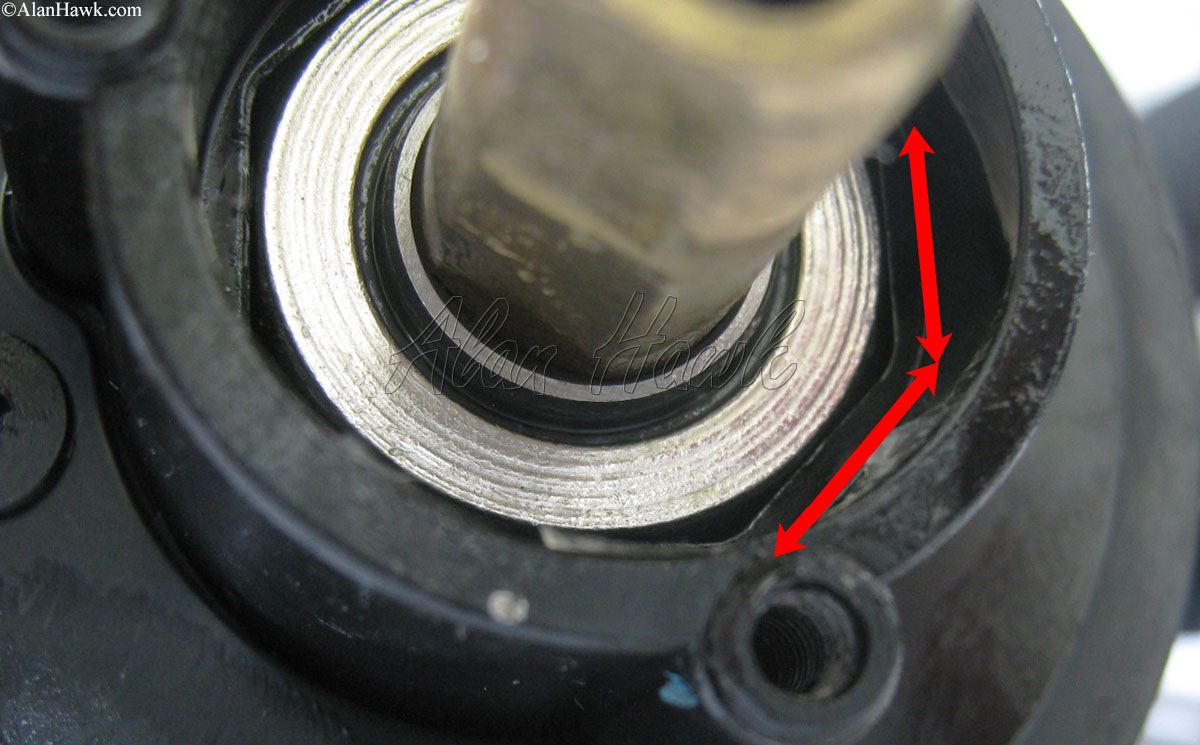
The anti-reverse clutch fits inside an octagonal recess that captures the clutch's octagonal body. The recess is slightly oversized, both because it's easier to produce it to looser tolerances as well as to accommodate dimensional variations between different production runs of clutches, which are manufactured by specialised suppliers, not by Okuma. That's perfectly normal for this type of clutch, and all that's needed for a flawless operation is something to gently press against it to keep it locked against the sides of the recess. This would eliminate any back-play in the rotor.
The principle might be hard to comprehend, how a gentle press on the clutch would eliminate all traces of play, but I promise you it does just that; the clutch's housing is only forcefully pushed in one direction, the locking direction when the rotor pushes backwards, but when the rotor spins forward no force is applied to the clutch's housing since that's the direction of free rotation. Therefore a small fabric washer lightly pushing against the clutch would not stop it from being pushed backwards once during assembly until it hits the walls and stops, then it remains in this position under the washer's gentle pressure as the rotor spins in the free direction from that point onward. Now when the rotor pushes backwards, the clutch's housing is already locked against the wall and there will be no back-play.
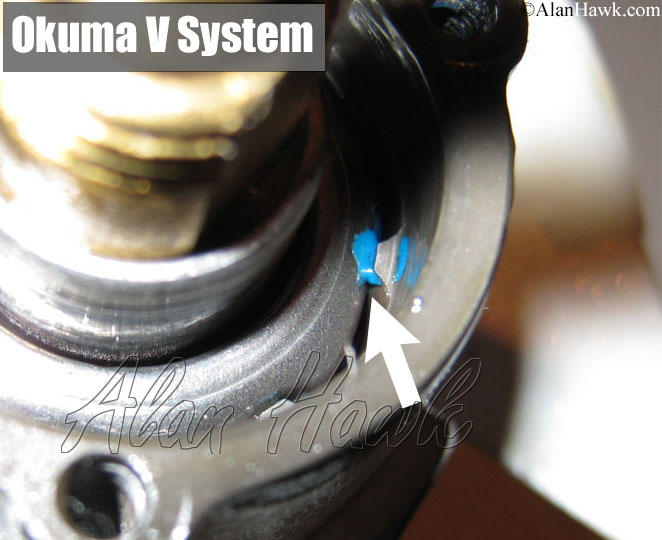
Okuma never really developed a reliable clean method to do this task, and instead they used to use thread-locker (Loctite) to hold the clutch against the wall of the recess, as seen in this screenshot from the 14 years old review of the Okuma V System reel.
They no longer do that, no alternative method was devised, and the clutch is left to play around in the recess causing the rotor back-play I showed you earlier in this review and in past articles. The housing of the clutch is integrally cast into the frame of this Cedros and the 2023 Salina, while it's a separate plastic piece that's screwed into the frame in the 2019 Azores, the 2024 Azores XP, and the 2019 Metaloid. I found the rotor play in all of them except the Salina, but my sample size of the Salina is only two reels therefore it's not indicative of an absence of the issue. As mentioned earlier, there are dimensional variations between different pieces of the same components, and sometimes by mere chance a clutch gets jammed in the proper location and the reel would have no play. Not every reel out there has the problem, but in my estimation most of them do.
Since it's a cheap reel of no further value to me I decided to test a new approach to deal with the play;
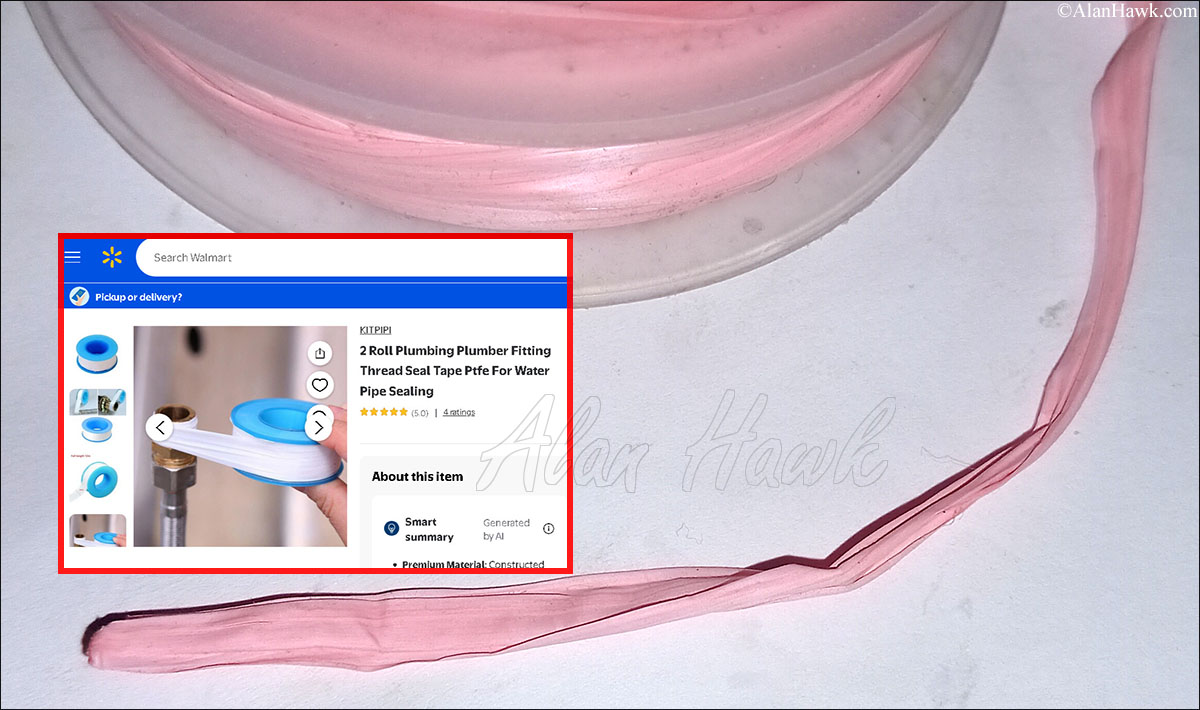
I wrapped the body of the clutch in pipe tape, which is relatively strong yet thin enough for me to customise a tight fit, then shoved it into its housing. This is not an ideal solution because now the clutch is held in the middle with the tape's fabric filling the gap between it and the wall, making the rotor stop feel mushy instead of a solid stop had it been directly locked against the wall. The reel no longer has back-play, though, therefore it's an improvement. The worst that could happen is the tape getting damaged with use and the rotor regaining its "factory" back-play. What a mess! Almost on par with Frasier Crane's in Nanny G's bed situation. But I digress, and you spring chickens wouldn't have a clue what I'm referencing anyway. Go watch episode 364 of the 104th season of whatever slop Netflix is vomiting, likely written by AI prompted by a blue haired pregnant "man" chosen as head writer solely for holding a university degree in "Decolonising Generationally Traumatised Lesbian Poems from an Indigenous Neurodivergent Perspective". But I digress, while already embroiled in an earlier digression, which is an unprecedented depth of failure.
The anti-reverse clutch is a common design that's found in the vast majority of spinning reels on the market; brake cylinders housed in a plastic cage, each under pressure from two limbs of plastic integral to the cage and acting as springs. The quality of both the steel and plastic in these generic units has been consistently improving and now even some of the cheaper ones have a good service life and can go for years without significant metal wear or the plastic springs taking a permanent set.
The above photo provides a good illustration of how these anti-reverse units work: if you look at the external metal housing right beneath the cylinder at 6 o'clock for example, you’d see that it's shaped as a short ramp climbing upwards from East to West. When the sleeve of the pinion rolls the cylinders clockwise, the cylinders go down the ramp into the deep end where they're free to roll. That's the rotor spinning normally and pulling line. If the pinion's sleeve reverses direction, it rolls the cylinders up the ramp where they get wedged against that sleeve and stop it. The power of this stoppage mainly depends on the number of cylinders and their length, which determine the total contact surface, as well as how far the cylinders are located from the centre of the pinion, which favours large diameter clutches grabbing wider pinion sleeves farther away from the centre, similar to the principle governing drag washers' diameter.
As for the speed of that stoppage, it largely depends on the quality of the springs, the dimensional accuracy of the braking elements, and the centrality of the clutch after assembly. The best clutches are allowed to float under controlled pressure not only to lock against the walls as described earlier but also to self-centre as they snap into that locked position. If a clutch is not precisely centred, the pinion's sleeve will be making more contact with some cylinders than with the others, delaying the "rolling" of the locking process described a minute ago since the farther cylinders would take longer to reach the sleeve and fully engage it for the lock, and when that lock finally happens it's not the most secure because the work is not spread evenly on all the cylinders.
Now why doesn't someone go crazy and create the greatest clutch imaginable by using a huge number of cylinders of extreme length, each under pressure from a powerful spring, surrounding a very large diameter pinion's sleeve? Well, because too much contact with the sleeve increases friction, which reduces the free-spinning of the reel and consumes more of the angler's energy winding it, accelerates wear, and a larger sleeve requires a larger clutch housing both increasing the cost and weight, in addition to that larger housing having higher inertia making it slower to respond and centre itself if it moves a little during a fight by the forces affecting the pinion. It's a very fine balancing act that requires superb engineering and full understanding of each individual reel's character, and clutches range from generic interchangeable ones to proprietary units designed specificity for the reel. It's one more aspect that makes what I do highly enjoyable and intellectually stimulating, and I seized the opportunity of this being a shorter review to take you deeper into the subject than I usually do.
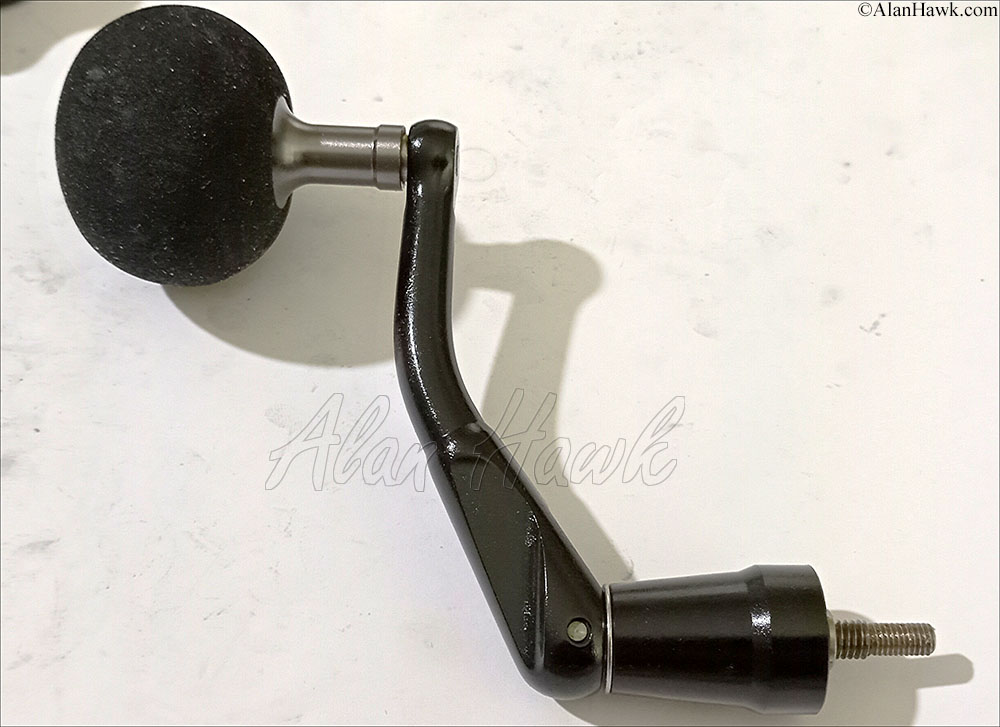
The machined aluminium handle is a design that Okuma continuously used for more than a dozen years in various models, and with only different colours and grips it comes with the Salina, Azores, and Azores XP. The Metaloid has a different handle with a reinforced joint. This handle does its job and there is nothing worthy of note about it, but the EVA ball grip is very difficult to clean due to its soft and fuzzy surface. If blood and bait get on it, they are in there for the long haul and might rot and develop smelly bacteria if not cleaned off thoroughly.
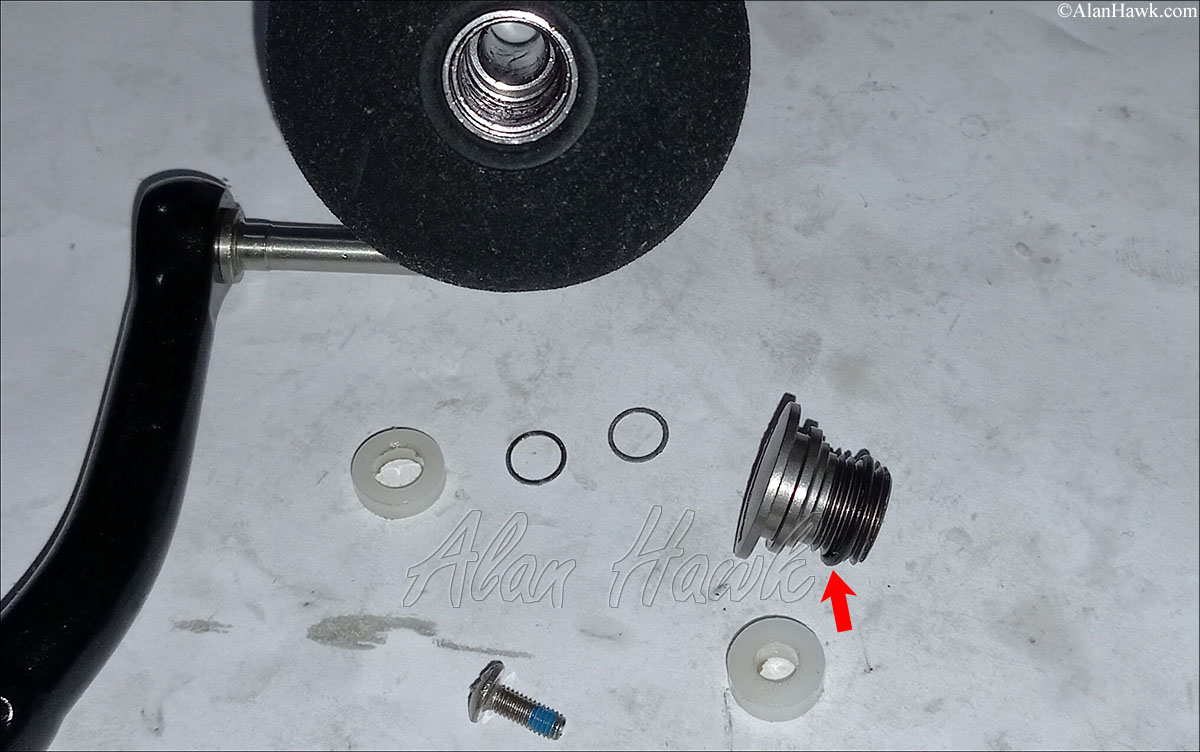
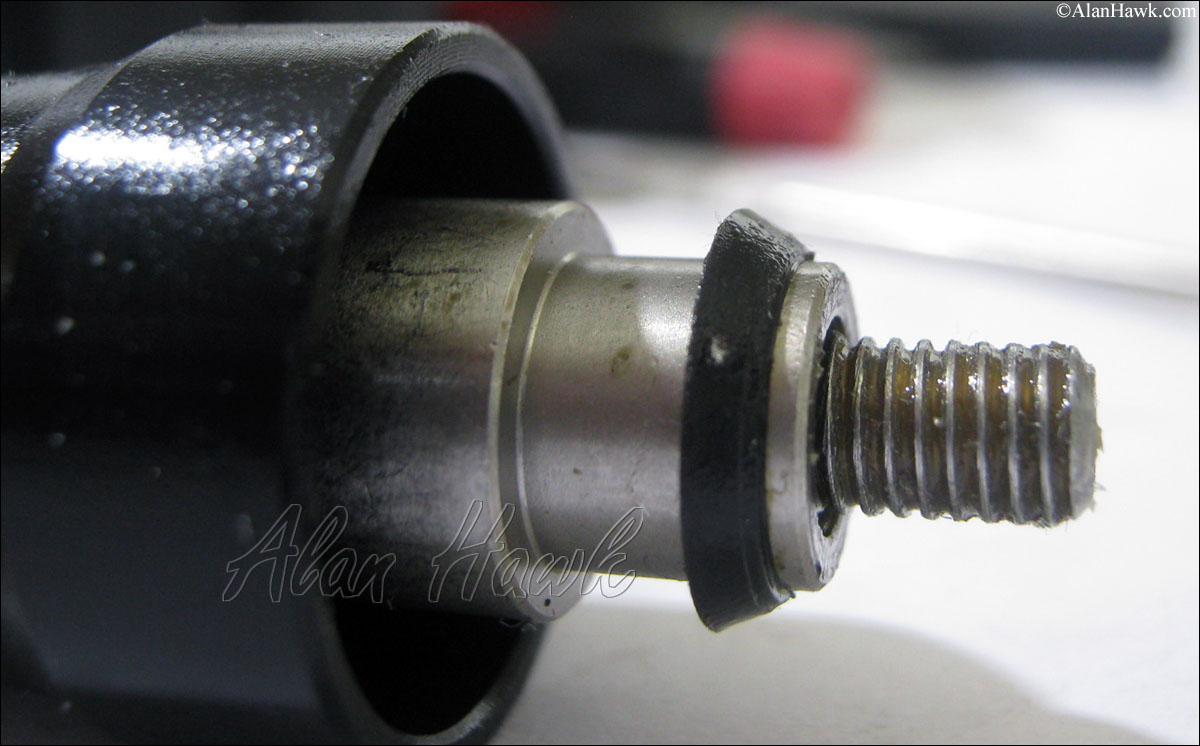
That EVA grip runs on two synthetic bushings, and it's sealed from the outside by a rubber ring (red arrow) mounted on its external screw. It turns smoothly and I had no issues with its operation in years of fishing.
The handle has a seal to keep water out of its opening in the gearbox....
And the cap that closes off the opposite opening has a seal as well. That cap is made of metal with a knurled edge for a secure grip between wet slippery fingers. I personally never need to swap the winding side while fishing with messy fingers, but people who fish in groups with several sets of rods and reels rigged differently might do this swap in the heat of action when a Leftie picks a rod that's just been used by a normal person or vice versa! Unfortunately the demonically possessed folks, euphemistically referred to as "left-handed" to obscure their abominable truth, live among and come fishing with us, and we have to accommodate them or their bodies would invert and spring into a reverse spider crawl around the boat screaming obscenities. I haven't personally witnessed that, but it's only a matter of time before I do..
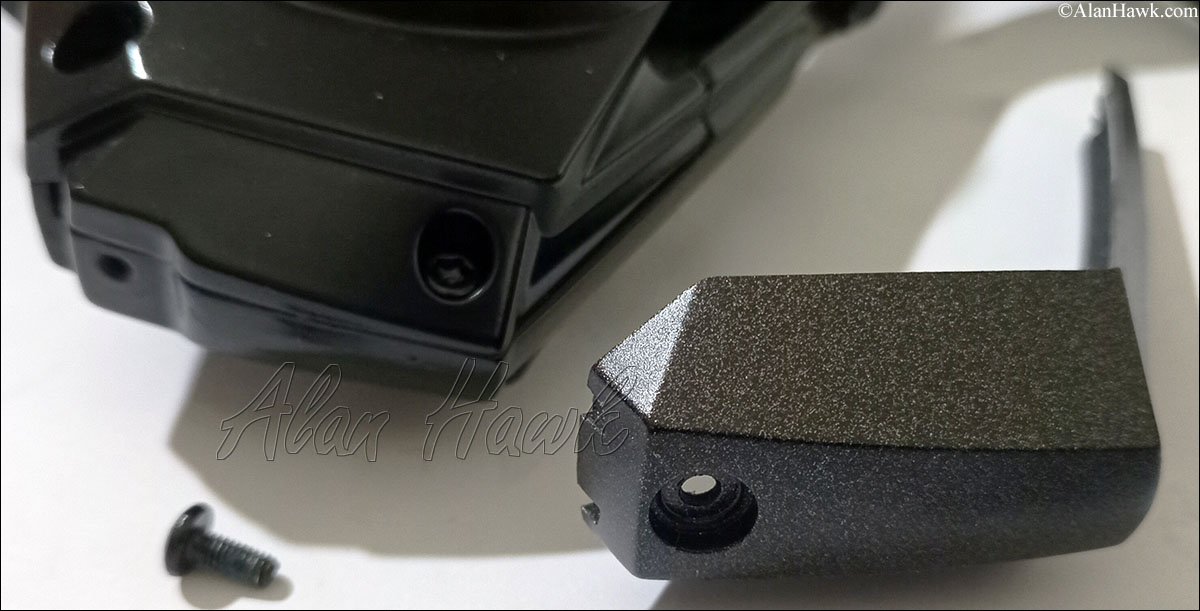
The plastic body bumper needs to come off before the gearbox can be accessed.
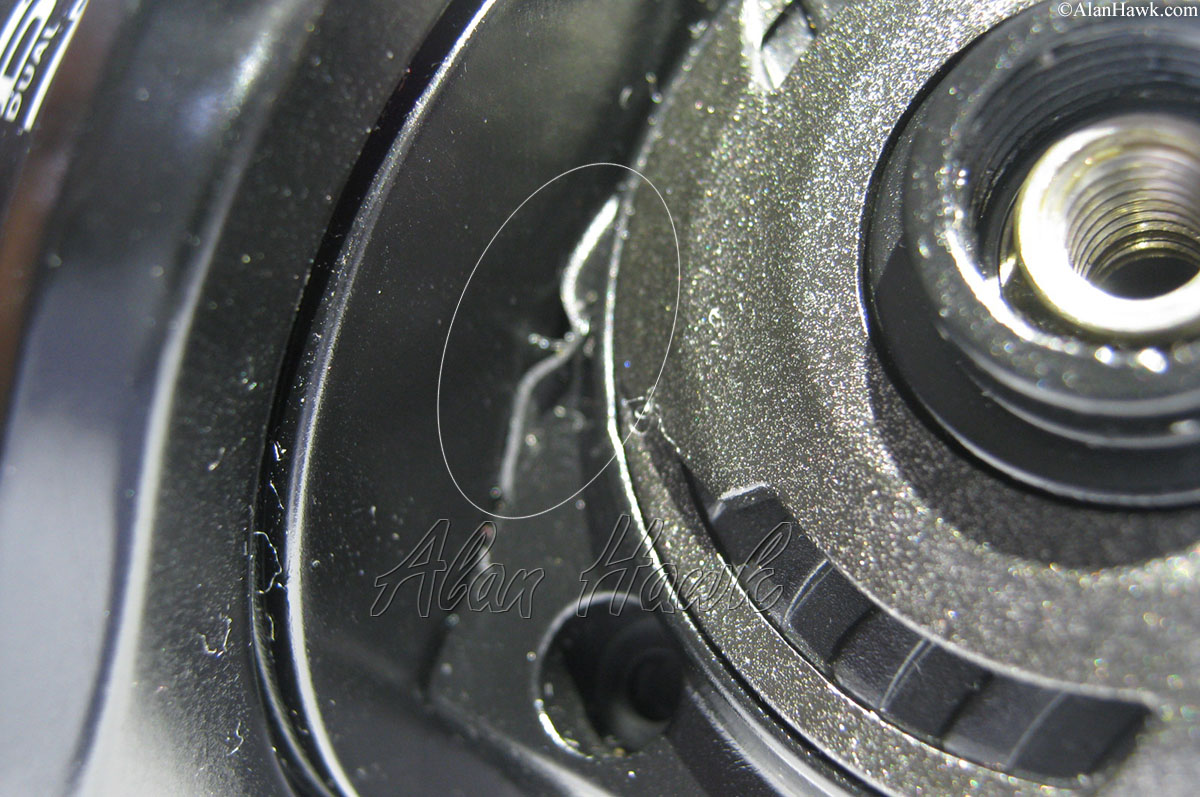
Spotted what looks like a twisted piece of rubber wedged between the side cover and frame....
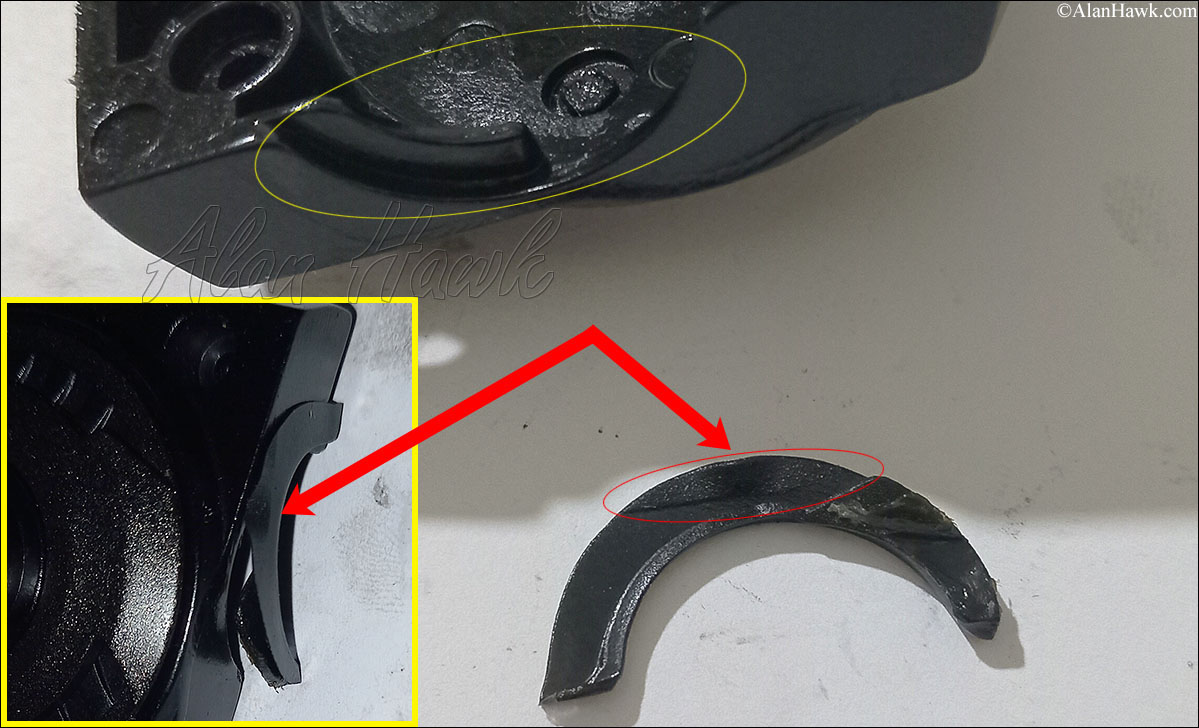
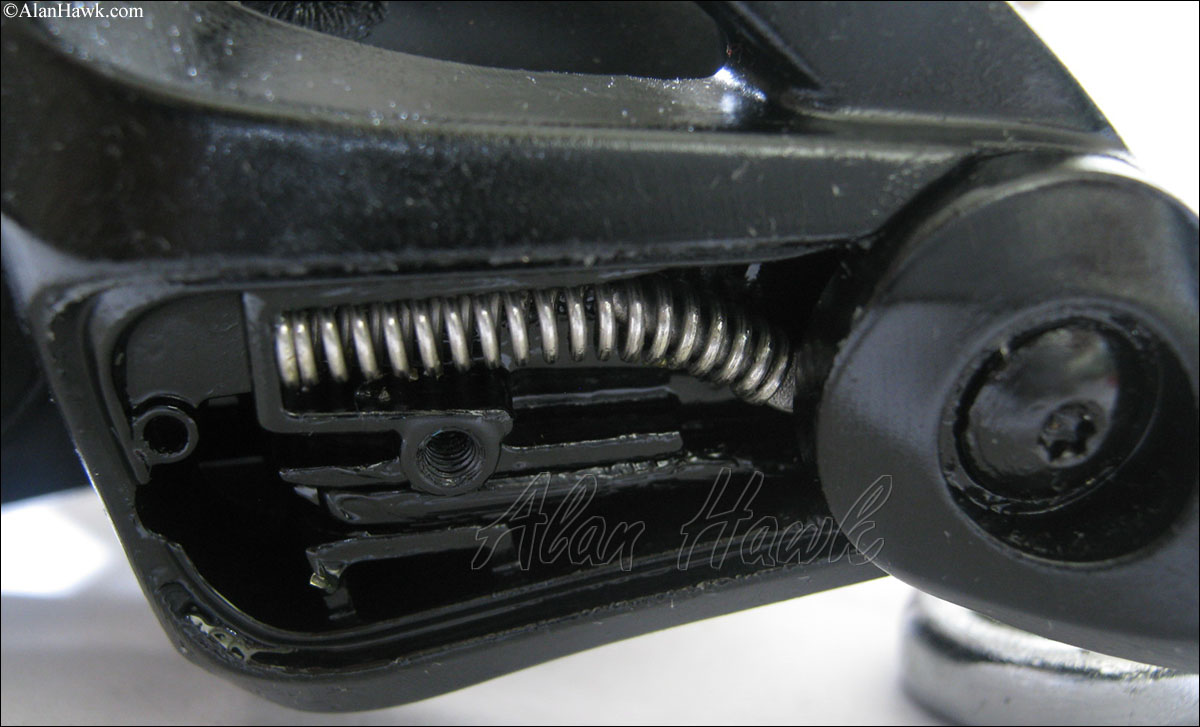
A half-moon piece of rubber protects the flange from water (inset), but it got dislodged and crushed during assembly leaving it with partial permanent deformation (red circled). I'm usually quite forgiving of assembly errors, unless obvious recklessness is involved, because humans are not robots and they make mistakes. I'm taking issue with this one, though, because is not purely an assembly error but rather a flawed design makes this error more likely to happen; the seating of this rubber piece is only half-walled (yellow circled) because an indentation made in the side cover for the drive gear interrupts the wall, leaving the rubber piece insufficiently secured and susceptible to dislodging and damage during assembly, which is exactly what happened here. Off the top of my head I can think of at least two or three alternative designs that would have avoided this, but instead they opted for an unnecessarily clumsy approach for reasons that remain unknown.
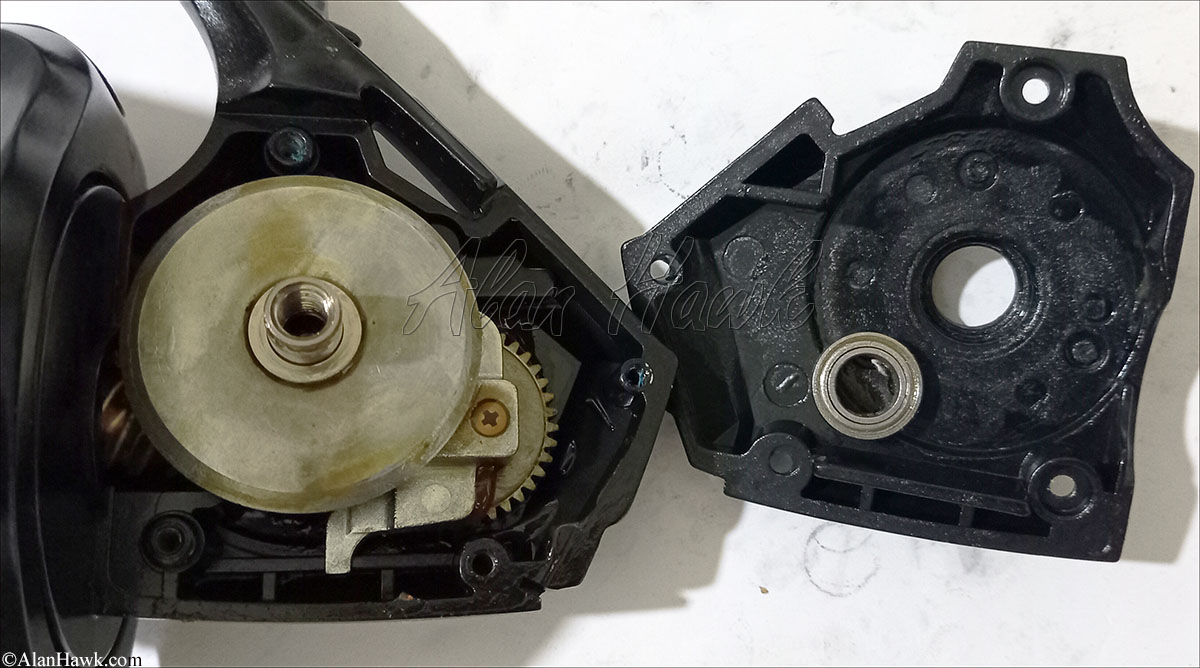
The side cover can be taken off without needing to disassemble the front portion, allowing the owner easy access to the mechanism for maintenance and lubing. Once inside I was greeted by the ball bearings of the drive gear, both of which are also standard shielded ones. These bearings being unsealed is not an issue since both sit next to openings that are protected as we've seen a while ago, yet one wonders why deny them an added layer of protection just in case water leaks into the gearbox through the unprotected pinion group?
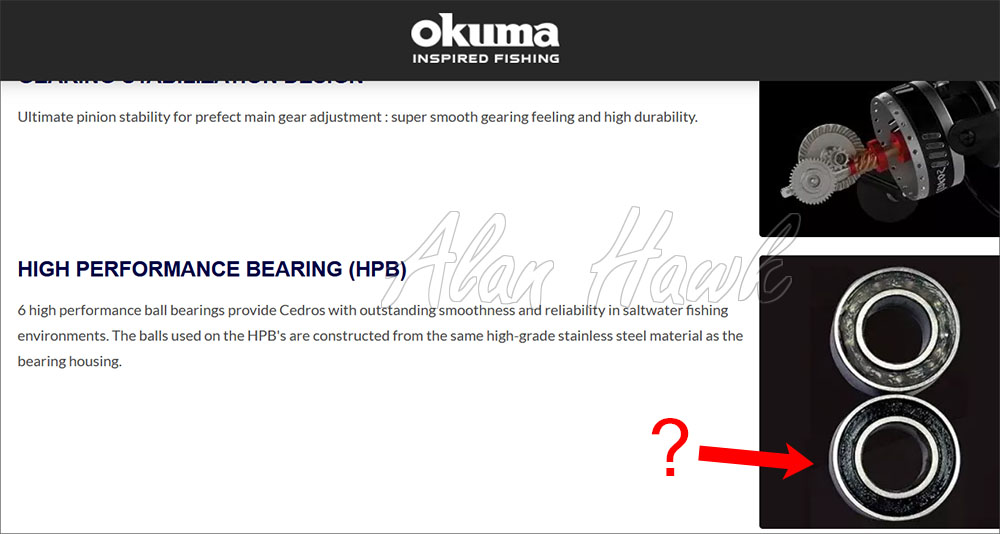
This picture from the Cedros' official listing is therefore inaccurate, since it depicts a sealed ball bearing when none in the entire reel are. At any rate, this Cedros is joined by the Salina in having shielded ball bearings, while in the Azores Blue, Metaloid, and Azores XP these drive gear bearings as well as the pinion bearings are sealed.
Important note; during the first year and a half of Covid many reels from various brands, including some super premium ones, occasionally resorted to using components that differed from the original designs due to shortages and supply disruptions, and ball bearings, being one of the components that's always bought from suppliers and never made in-house, were the most affected by this practice. I've examined several reels from different brands made between 2020 and 2023 that came from the factory with replacement bearings among other substitutes, such as different types of screws, washers made of replacement materials, parts missing the standard finish, etc. This is something that I've caught while doing what I do, which I don't believe has been publicised or spoken of before, and I kept good records for a potential article about those crazy times at one point in the future. Anyhow, I have not seen substitute bearings in any of the Okumas discussed here, but letting you know nonetheless just in case such substitutions had taken place without me seeing them and you happen across a bearing or two in your reels that differ from what I've just outlined in the quintet.
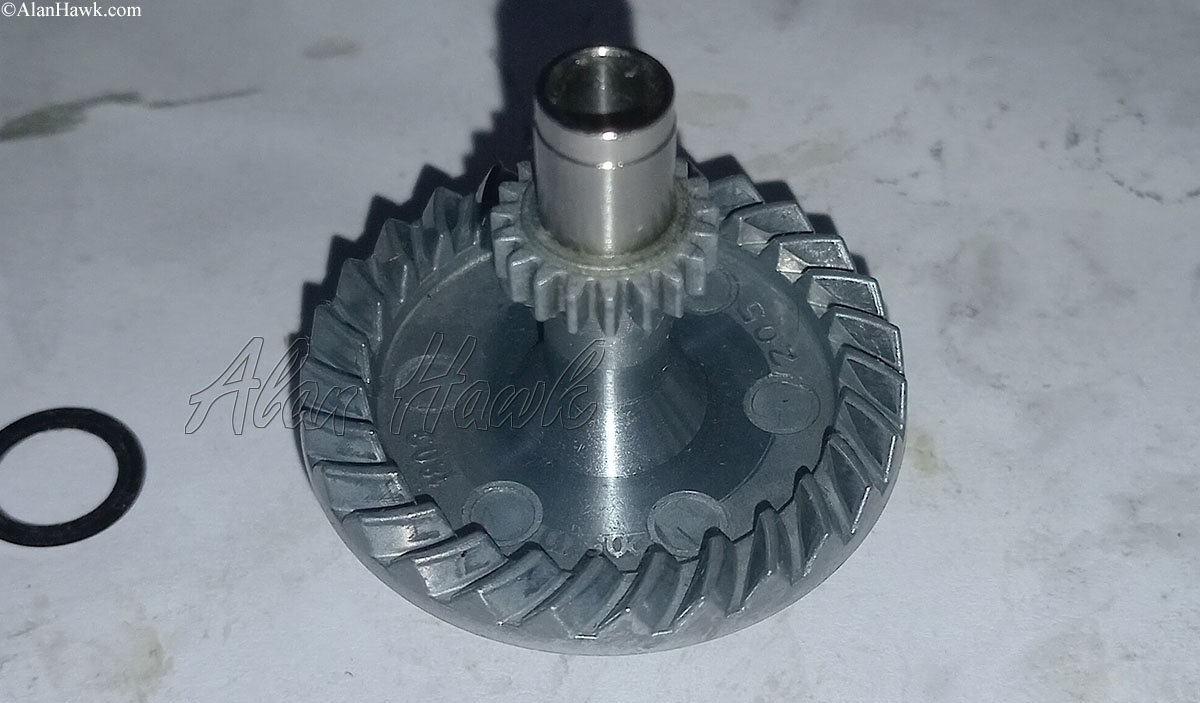
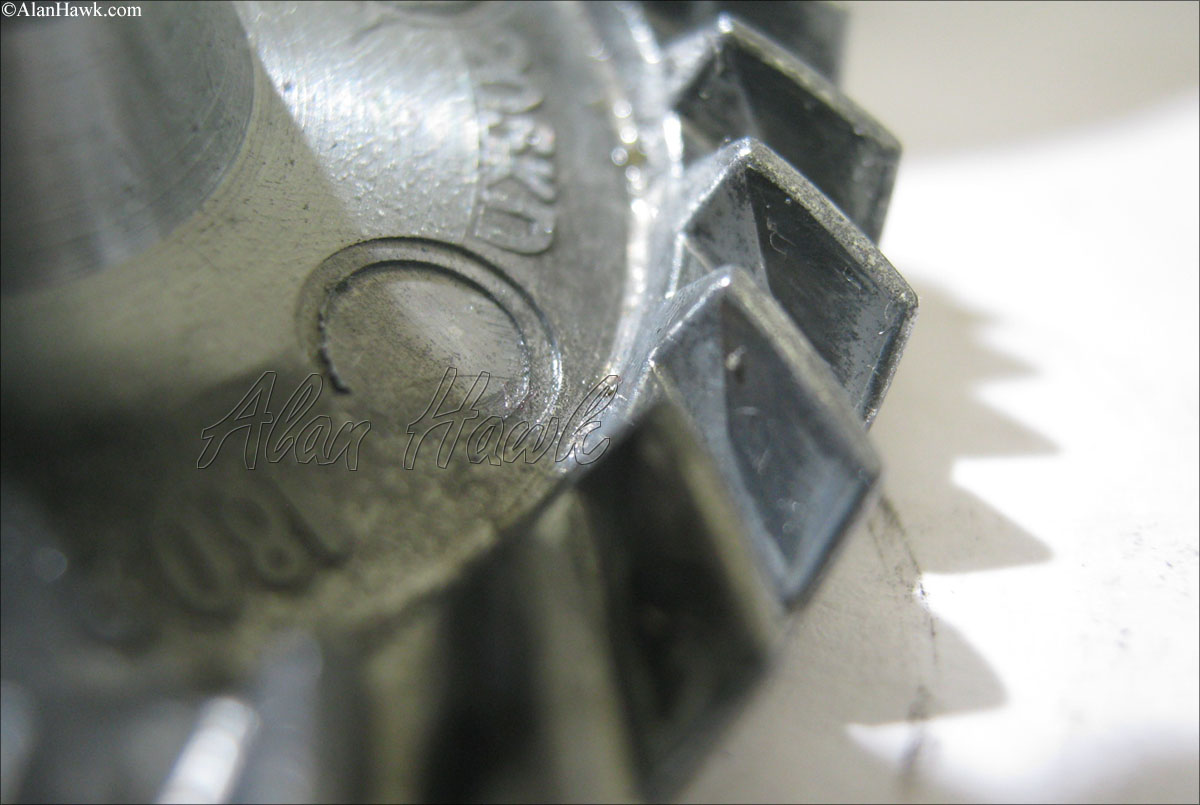
The drive gear is of a larger diameter than the average, and its size was utilised cleverly with teeth that are also above average in size for added strength.
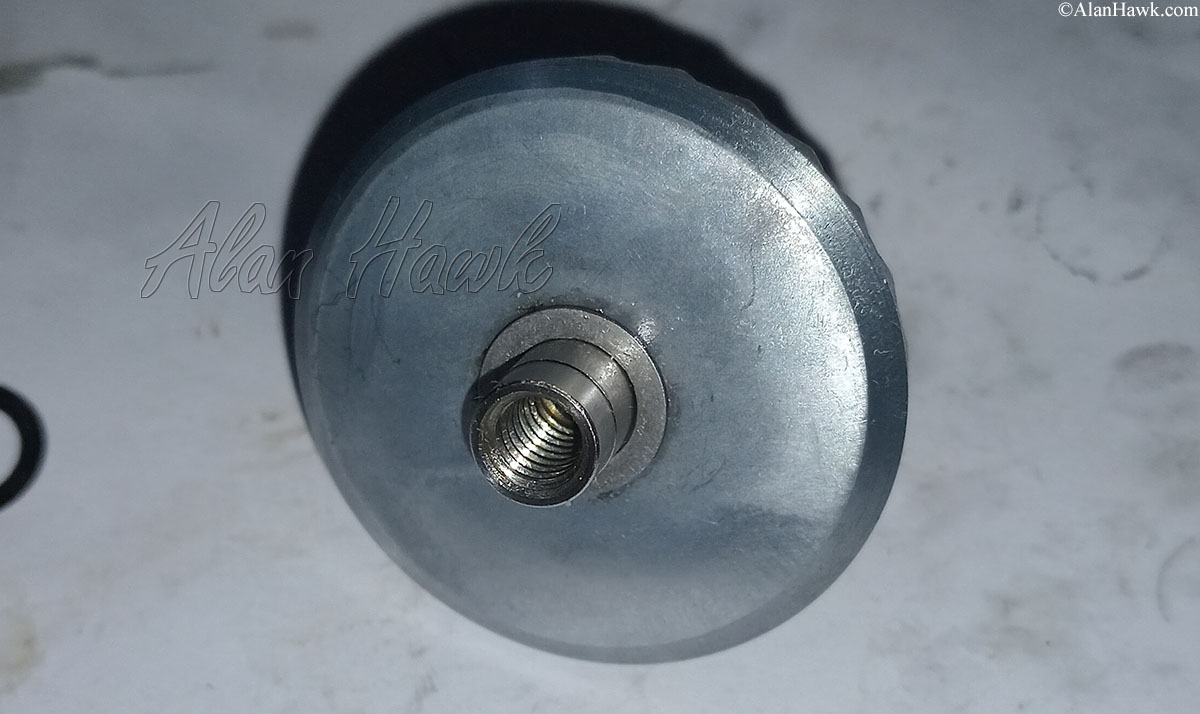
That gear is made of zinc alloy formed by casting, with a stainless steel shaft going through it. With only some peripheral differences that don't alter any fundamental performance characteristics, this gear build powers the entire quintet of Okumas that are the subject of this review.
Wear marks on the teeth indicate about 60% surface engagement with the pinion, which is acceptable for a reel of this price and class, and the rate of that wear is in my assessment slower than a typical cast zinc gear that has seen a similar amount of use. The wear rate would've been even slower had the gear contacted the pinion across a larger area than the 60%, spreading the load for increased durability and strength, but one can't realistically expect the precision of higher tier reels from this ~ $220 series.
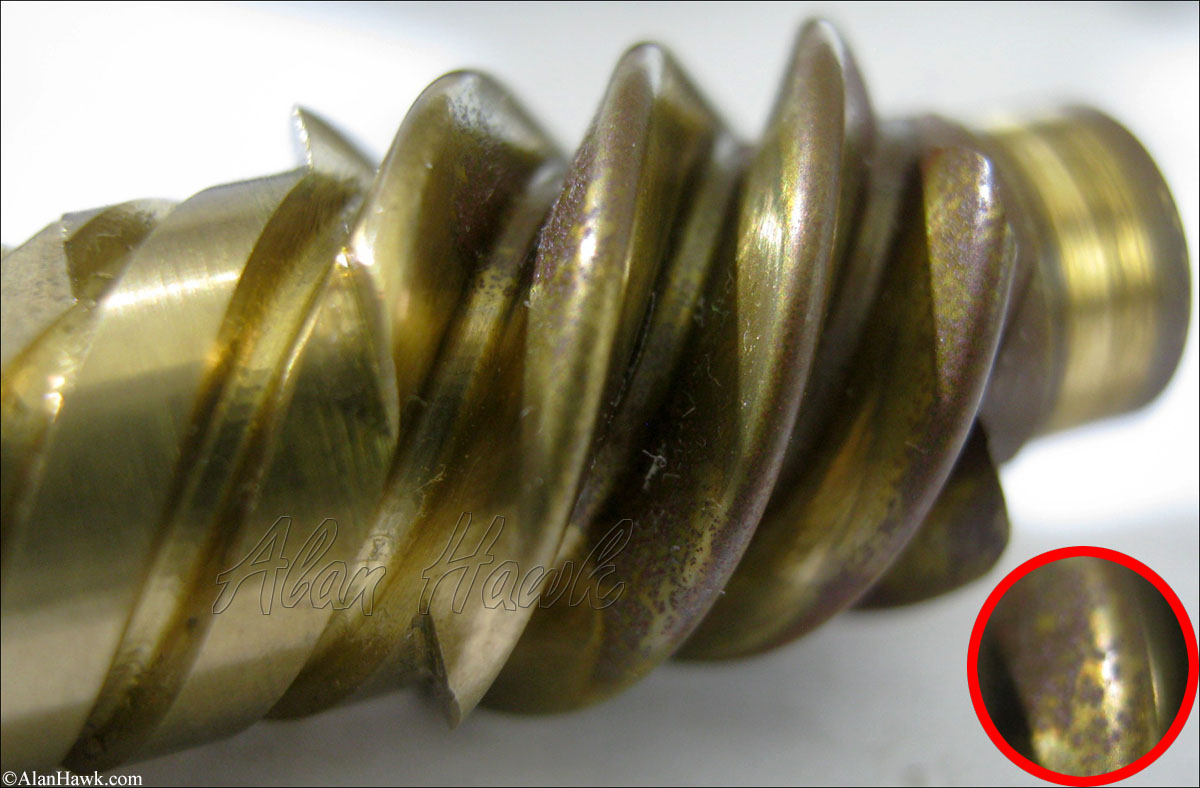
The machined brass pinion is robust enough to complement the large teeth of the drive gear, and it shows, expectedly, less wear than that drive gear. Here it developed some tarnishing, zoomed in the inset image, which is brass oxidation often initiated and accelerated by moisture. It's largely cosmetic with negligible effects on the structural integrity of the pinion, yet it highlights how choices have consequences and in this case it was the choice to install no protection for the pinion assembly. Had only one of the pinion bearings been sealed the amount of moisture allowed in would've been dramatically cut down.
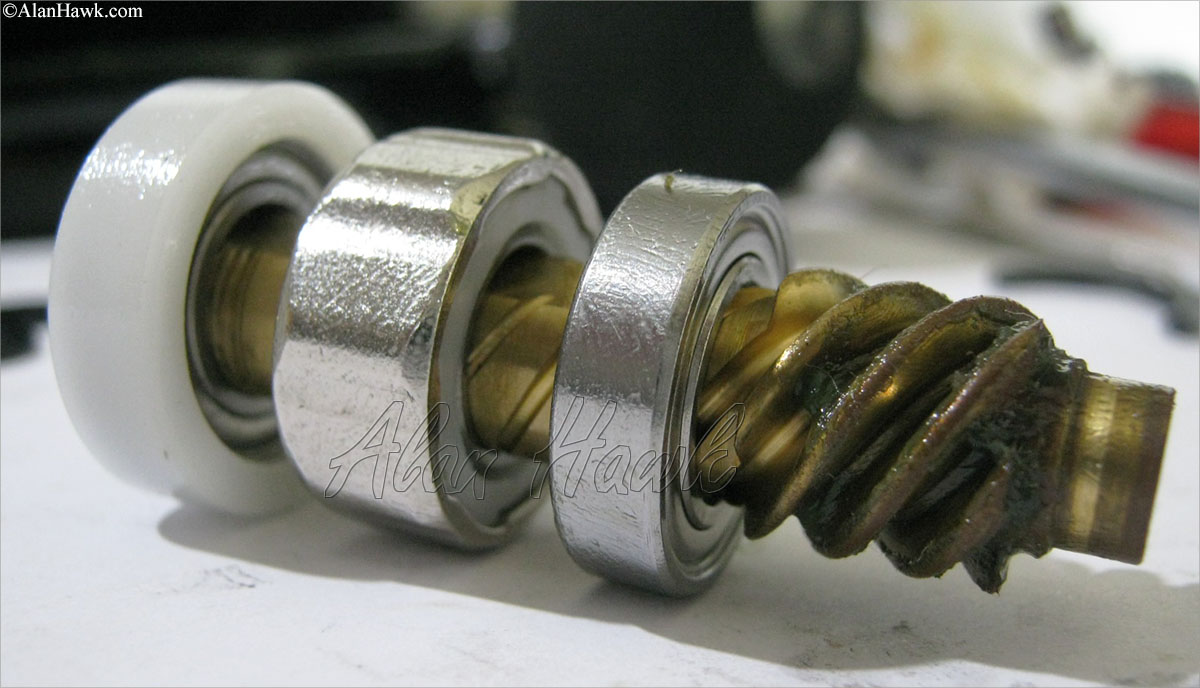
Said "one of the bearings" because this pinion has two of them, sandwiching the anti-reverse clutch. I am a fan of this setup; two bearings fully stabilise the pinion, and them hugging the clutch protects the innards of that clutch from any excessive friction caused by potential deflections in the pinion under loads. Not that this reel is capable of producing the amount of drag that would make this a possibility, still it's a nice reassuring touch.
With the pinion fully stabilised by two bearings at the outer end, this synthetic pushing for the inner end of the pinion isn't particularly necessary. No complaints here, it weighs nothing and causes no harm, so keep them coming.
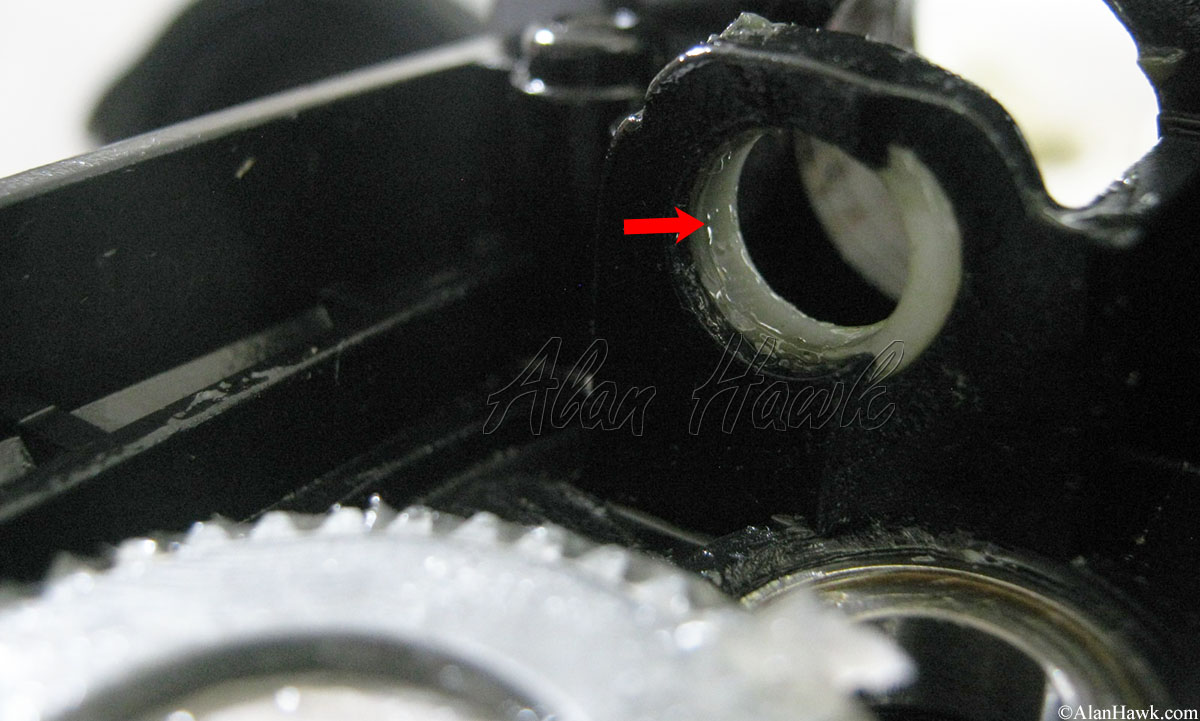
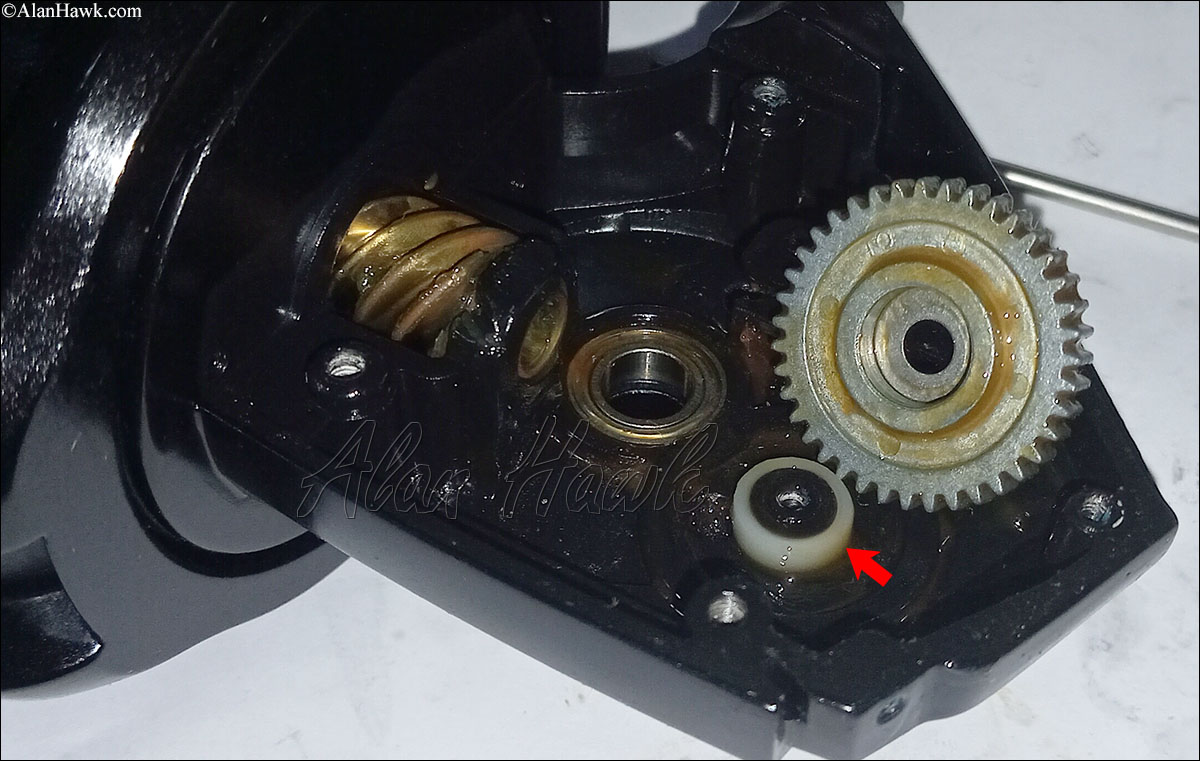
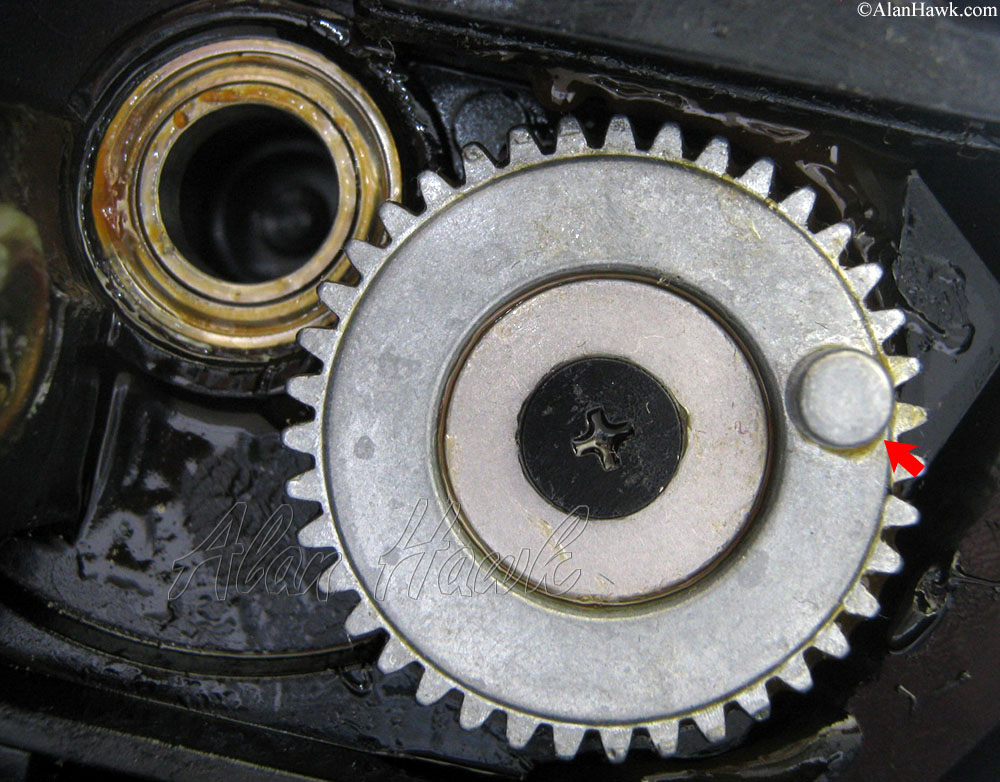
The locomotive oscillation gear is cast zinc as well, and it rides on a thick synthetic bushing to reduce friction against the frame.
The vertical post that engages the oscillation block is an integral part of the cast, and it connects directly to the oscillation block without sleeves or rings in-between, therefore it's a high friction and high wear connection.
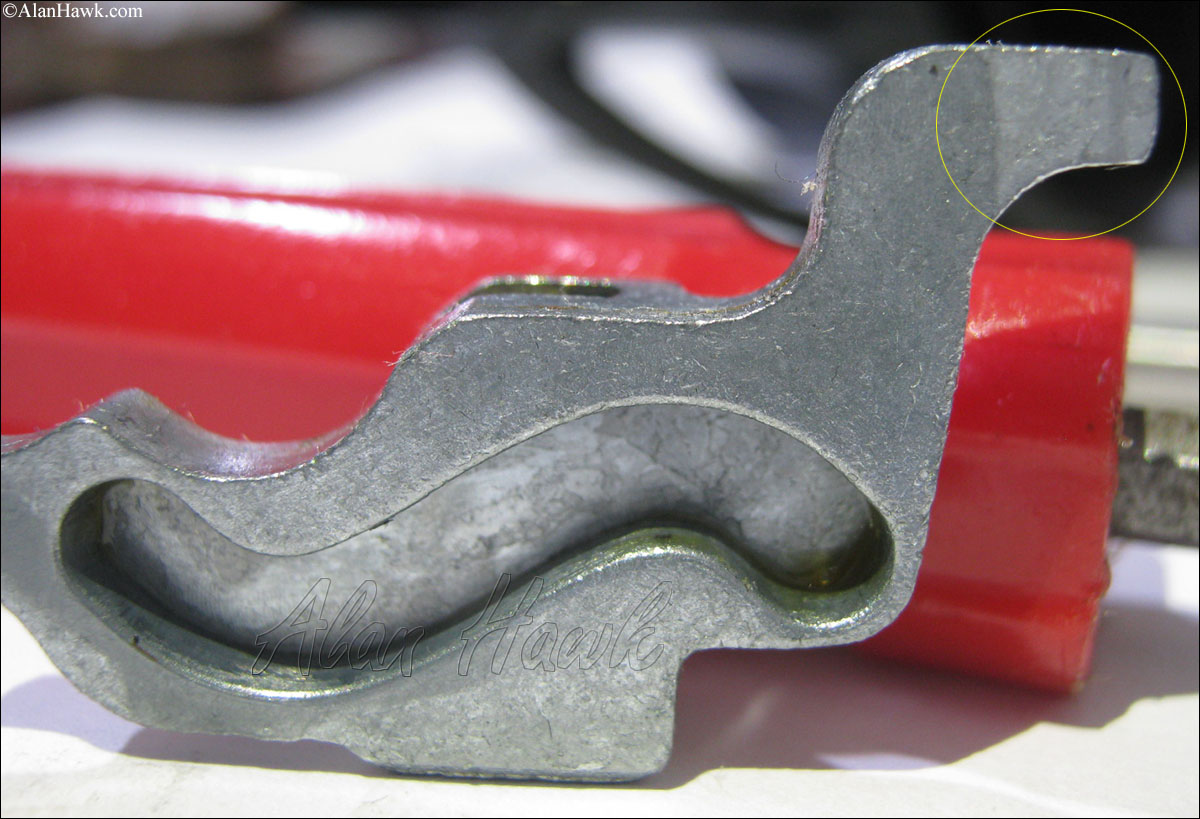
This oscillation block is afflicted with an even worse frictional wear that causes volume loss at its lower tip (circled)....
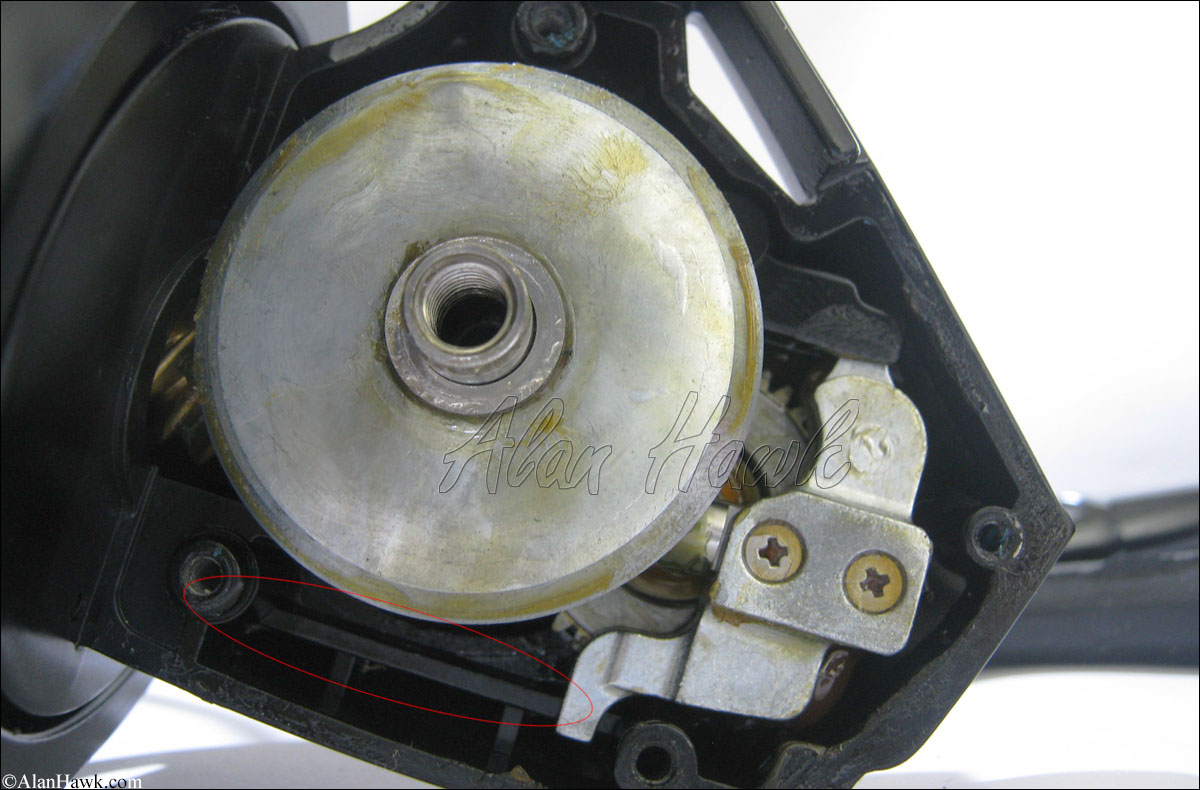
That's due to this tip riding on and rubbing against the frame's metal during operation, and the friction increases greatly when reeling against resistance be it a fish or even a larger lure. In addition to causing the rapid wear shown in the previous photo, this friction creates roughness and wastes the fisherman's energy when reeling under load. This is not just an outdated approach, it's truly ancient in today's world. For almost 15 years now many reels from competing brands, some of which cost half as much as this Okuma, come with systems of one configuration or another that mitigate this phenomenon and enable smoother sliding that saves energy and increases parts' longevity.
The 2023 Salina has an identical setup to this 2020 Cedros, while the 2019 Azores Blue, 2019 Metaloid, and the 2024 Azores XP have a plastic cage inside the gearbox, which Okuma calls "MSS" (Mechanical Stabilizing System), and the oscillation block of these 3 models slides on the tip of this plastic cage. Not ideal, yet certainly an improvement over the bare metal coupling in the Salina and Cedros.
As an aside, in the 3 models with that "MSS" the right side ball bearing of the drive gear sits in this plastic cage while the left bearing sits in a plastic insert attached to the side cover. That's neither here nor there, just a small detail for completeness.
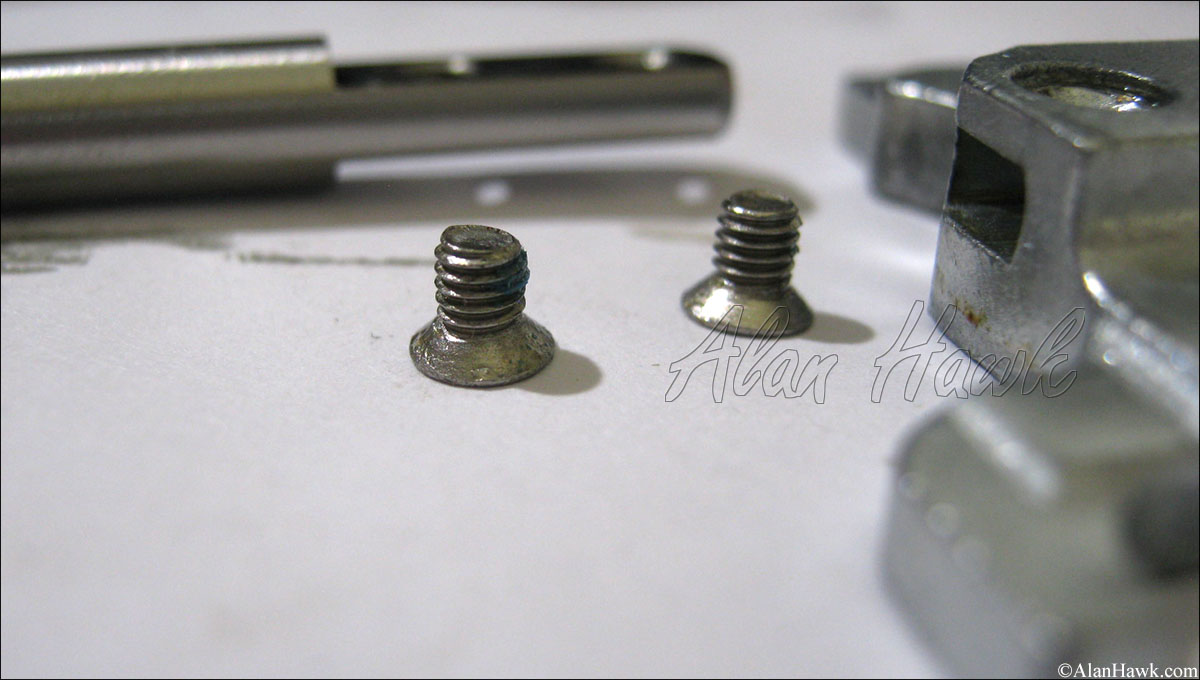
The screws holding the oscillation block to the main shaft are short, but they had thread-locker applied during assembly, and the soft alloy of the block creates a quasi-rubbery grip on their heads so they remain securely fastened. I would have made a fuss had these short screws been in a heavier duty reel, but they are alright for the Cedros. Just make sure to reapply thread-locker on them if you ever take them out or else you'd be asking for trouble.
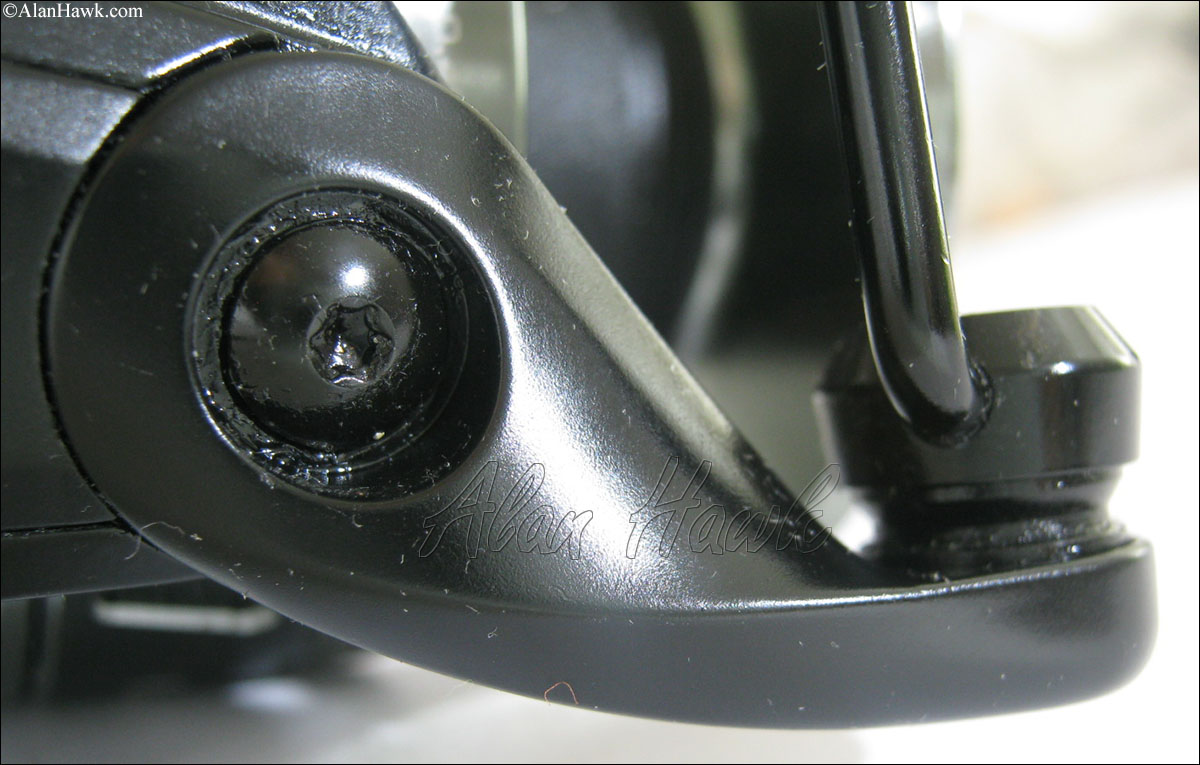
The bail mechanism is a classic setup whose simplicity has proven reliable enough for Okuma to forgo any attempts to change it. Another part of the Cedros that worked without a single hiccup.
The finish of the metal bail arm is as tough as the arm itself. Good stuff.
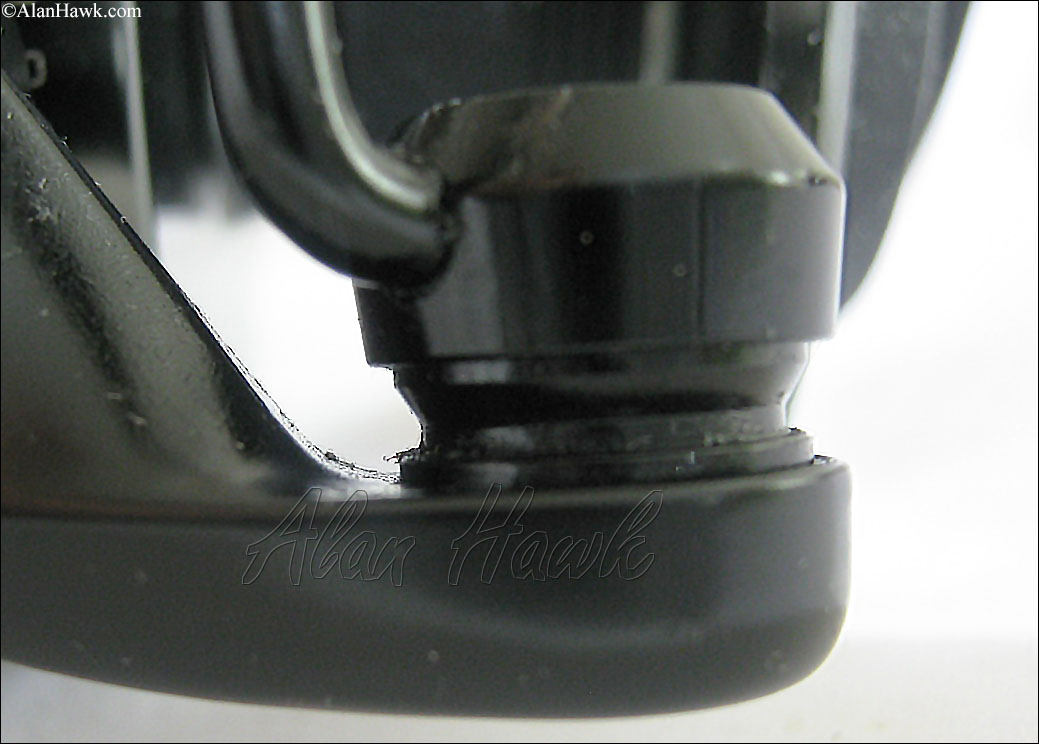
The line roller's finish is even better, still looks new after hundreds of hours of work. The roller's lower rim is of proper height to keep the braid from contacting the bail arm at any angle or spool position, a little detail that not every brand out there has fully mastered.
That line roller spins on one ball bearing (red arrow) and one synthetic bushing (yellow arrow). The ball bearing is not sealed, nor is the line roller itself, something one expects would cause issues, yet they survived real life use unscathed. Unsealed rollers combined with unsealed bearings did give me problems in other reels that I reviewed, but not this one. Can't definitively pinpoint the reason, but my best guess is the synthetic bushing shielded the bearing from one end while the other end had such small gaps that water couldn't penetrate them easily. Regardless, all is well and I won't need to upgrade this part.
The 2020 Cedros is relatively light, casts reasonably well, lays line decently enough not to suffer digging issues, yet fishing it was not a pleasant experience at all. The rotor back-play kept making its presence known no matter how much I tried to ignore it, either through unmissable rearwards slams when jigging or conspicuous jerking of surface plugs during sweeps. When the felt washers were fresh I had to set the drag lower than I desired to negate the small but perceptible starting spike, and as the felt dried and aged I gradually gave up on the drag and let my fingers/palm do its job which was nothing short of nasty. I couldn't even enjoy the one outstanding feature of this reel, the rigid hybrid alloy, since its main manifestation in a reel of this class would've been instantaneous drag response in absence of flexing that absorbs line pulls and delays drag start. The stickiness built into this drag from the get go virtually nullified this potential perk. Lastly, while the Cedros has some pulling power, a good portion of that power vanished the second there was a fish at the end of the line, something I'm convinced was caused by the oscillation block rubbing against the body as evidenced by the advanced wear shown earlier.
The rotor play effectively makes this Okuma a defective product that isn't worth buying, but even without it, the 2020 Cedros is in my opinion a decisively outdated design that's long been surpassed by what the competition offer in terms of drag performance, durability, sealing, and winding power under load. I didn't want to mention this earlier not to inject one more reel into a review confusingly loaded with different reels, but the foundation of this Cedros as well as the rest of the quintet is rooted in the design of the 2014 Azores "silver" reel, with certain concepts going even further back well into mid 2000s. Had this review been written 12 years ago I'd have ended it by hoping for a fix for the rotor play so I could recommend the reel to people on a tight budget who're willing to keep oiling the felt washers, but in this day and age and for what the Cedros costs now my only recommendation is to fully retire this platform and relaunch something that hopefully embodies the vision and ingenuity with which Okuma created the Tesoro and the Makaira, my reservations about both notwithstanding.
That's all for now. I wish you all a magnificent Christmas filled with love and joy.
Cheers
If you value what I do and want to support my work and upcoming projects, please click HERE. Always appreciated.
Alan Hawk
November, 19th, 2026
REVIEWS BLOG TOP REELS CONTACT HOME